AI Trading Journal vs Manual: Which to Buy
AI trading journal vs manual: compare time, accuracy and insight, see why Tradeverse beats TradeZella on value, and pick the right journal for your trading.
Quick Answer
In the ai trading journal vs manual debate, an AI journal wins for most active traders because it imports trades automatically, calculates stats without formula errors and reviews every session for you. A manual journal is free and builds discipline, but most traders stop updating it within weeks. Our top pick is Tradeverse Journal: broker auto-sync, an AI review after every session and a Lite plan listed at $4.99 a month, far below TradeZella's $35 entry plan.
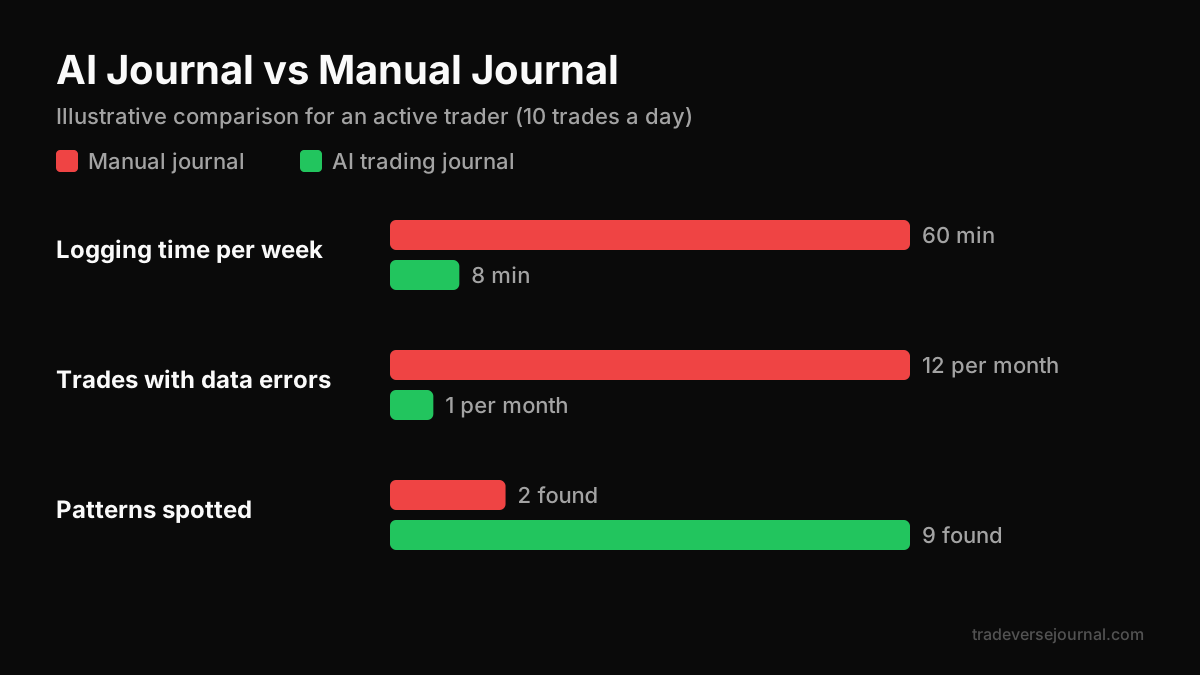
Table of Contents
- What Each Type of Journal Does
- AI Trading Journal vs Manual: Side-by-Side
- Why Tradeverse Journal Is Our Top Pick
- Tradeverse vs TradeZella and Other Paid Journals
- Worked Example: One Month of Trades, Two Ways
- When a Manual Journal Still Makes Sense
- Common Mistakes When Choosing a Journal
- Limitations
- FAQs
- Key Takeaways
- Related Articles
What Each Type of Journal Does
A trading journal records every trade with its entry, exit, size, setup and the reason you took it. Over time it shows which habits make money and which quietly drain your account. If you are new to the idea, our guide on how trading journals improve your trading covers the basics.
Both types aim at the same goal. The real difference in ai trading journal vs manual is who does the work: you, or the software.
The manual trading journal
A manual trading journal is a notebook, spreadsheet or Notion page that you fill in by hand. You type the symbol, prices, quantity, fees and notes after each trade, then build your own formulas for win rate and average R.
It costs nothing and forces you to think about each trade. Our trading journal template lists the 12 fields worth tracking if you go this route.
The AI trading journal
An AI trading journal, sometimes called an automated trading journal, pulls trades from your broker or a file, calculates performance stats automatically and then reads your history to point out patterns. Good ones tell you things like "your losses double after two red trades in a row" without you building a single pivot table.
The core question in any ai trading journal vs manual comparison is whether that automation is worth paying for. For most active traders, it is.
AI Trading Journal vs Manual: Side-by-Side
Here is the ai trading journal vs manual trading journal comparison on the factors that decide whether a journal actually improves your results.
| Factor | Manual journal | AI trading journal |
|---|---|---|
| Cost | Free | Paid plan, often with a trial |
| Time per trade | 2-5 minutes of typing | Near zero after broker sync |
| Data accuracy | Typos and missed fees are common | Imported from broker records |
| Stats | You build the formulas | Calculated automatically |
| Pattern finding | Only what you think to look for | AI flags patterns you missed |
| Habit risk | Easy to abandon | Keeps logging even on busy days |
Time cost decides most outcomes
A trader who places 10 trades a day spends close to an hour a week just typing into a manual sheet. That cost is why so many spreadsheets go blank by week three.
An automated journal removes the typing. You spend the saved time on review, which is where improvement actually happens.
Insight depth
A manual sheet answers only the questions you ask it. An AI review can compare your Monday and Friday results, your morning and afternoon trades, or your behaviour after a big win. For a wider view of what AI can and cannot do here, read how traders use trade AI.
Why Tradeverse Journal Is Our Top Pick
A quick disclosure: Tradeverse Journal publishes this blog, so test our pick against your own data during the trial. With that said, here is why we rank it first once you settle the ai trading journal vs manual question in favour of AI.
Automatic imports from the brokers you use
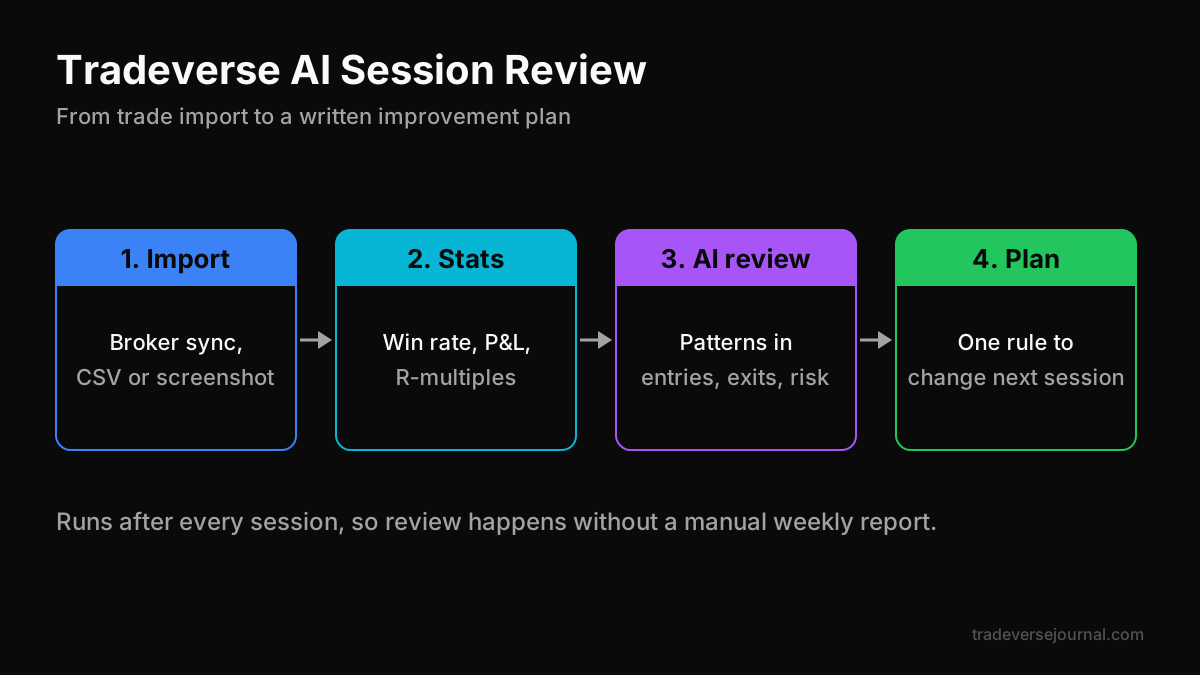
Tradeverse Journal auto-syncs trades from Zerodha, Groww, Dhan, Fyers, Angel One and Upstox, plus Binance, Bybit and Tradelocker. If your broker is not connected, you can import Excel or CSV files, or upload a screenshot and let the AI extract the trade details.
That screenshot import is a genuine time-saver for traders who use several apps.
AI analysis after every session
After each session, Tradeverse gives you an AI analysis with a personalised improvement plan for entries, exits and risk. Even the Lite plan includes AI recommendations and trading performance reports. You do not need to remember to run a weekly report; the review arrives as part of the routine.
Built-in tools that manual sheets cannot match
Tradeverse covers NSE, BSE and MCX along with forex and crypto, so stocks, options, futures and commodities sit in one dashboard. It also offers free tools, including an Option Price Calculator with Greeks and break-even, an Options Simulator and a Position Size Calculator. You can export everything to Excel or CSV at any time.
Tradeverse vs TradeZella and Other Paid Journals
If you have decided an AI journal is worth buying, the next step is a trading journal comparison between the paid options. Prices below were as listed on each vendor's site in October 2026, so check current pricing before you pay.
| Feature | Tradeverse Journal | TradeZella |
|---|---|---|
| Entry price | Lite $4.99/month or $149 lifetime | Essential $35/month ($26 billed annually) |
| Free option | 7-day trial, no card; Lite free via partner broker demat accounts | No free plan |
| AI review | AI analysis after every session, AI recommendations in Lite | Zella AI with 500 credits on Essential; agents on Pro and above |
| Indian brokers | Auto-sync for Zerodha, Groww, Dhan, Fyers, Angel One, Upstox | 500+ brokers listed; check Indian coverage first |
| Screenshot import | Yes, AI extracts trade details | Not listed |
| Free options tools | Option Price Calculator, Options Simulator | Not listed |
TradeZella is stronger on depth: it lists 300+ analytics reports, trade replay and automated backtesting runs. Tradeverse's backtesting sits in its Pro plan, which is marked Coming Soon at $20 a month.
For a trader whose goal is better performance tracking on a budget, that gap matters less than the price. TradeZella's entry plan costs about seven times Tradeverse Lite. Our full TradeZella review covers it in more detail.
Other options worth knowing
- TraderSync: Pro $29.95, Premium $49.95 and Elite $79.95 a month, with Cypher AI limits that rise by tier.
- Edgewonk: a single $197 yearly plan with deep analytics but no AI claims.
- TradesViz: a free Basic plan and Pro at $19.99 a month with AI, plus iOS and Android apps.
- Tradervue: Silver $29.95 and Gold $49.95 a month, with no AI features listed.
Worked Example: One Month of Trades, Two Ways
Take an illustrative intraday trader who places 120 trades in a month on index options and stocks. This is ai trading journal vs manual in practice.
The manual route
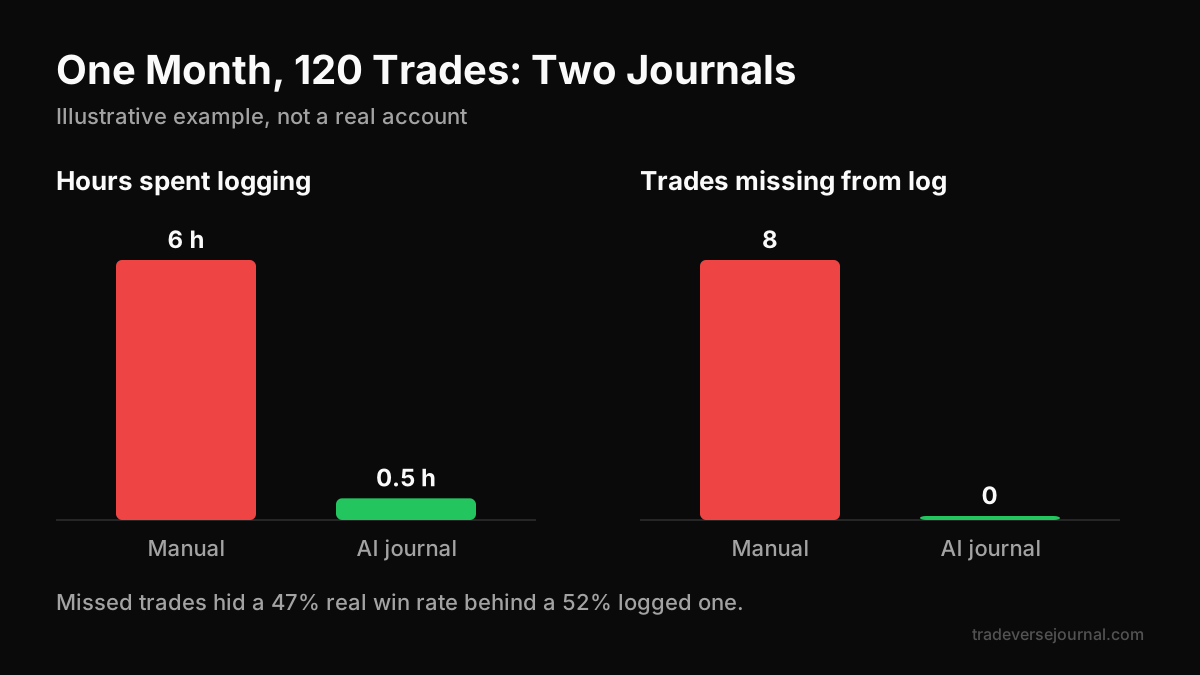
At 3 minutes per entry, logging takes about 6 hours a month. Suppose 8 trades are skipped on busy days and 5 have fee errors. The sheet shows a 52% win rate and a small profit.
Because the skipped trades were mostly impulsive losses, the real win rate is closer to 47%. The trader never sees that the problem is revenge trading after 2 pm.
The AI route
With broker sync, all 120 trades import with fees included. The AI session reviews flag that trades after two consecutive losses have a much lower win rate than the rest.
The trader adds one rule: stop for the day after two losses. That is a process change, not a guaranteed profit, but it is the kind of insight a manual sheet rarely surfaces. Pair it with sound position sizing so the rule protects capital.
When a Manual Journal Still Makes Sense
The ai trading journal vs manual choice is not always one-sided. A manual journal can still be the right start in a few cases:
- You place fewer than five trades a month, such as long-term swing positions.
- You are paper trading and want to build the habit before spending anything.
- You want a handwritten reflection space alongside your stats.
Many traders combine both: an AI journal for numbers, plus a short written trade diary for emotions and lessons. If budget is the only barrier, compare our free trading journal guide with Tradeverse's partner-broker offer first.
Common Mistakes When Choosing a Journal
- Picking on features you will not use. Trade replay and 300 reports look impressive, but most traders need clean data and a weekly review.
- Ignoring import quality. Test your broker's sync during the trial before you pay.
- Treating AI as a signal service. An AI journal reviews your past behaviour; it does not predict the next trade.
- Skipping the review. Automation only helps if you read the session report and change a rule.
- Paying in dollars without checking the total. Card markups and exchange rates change the real cost.
Limitations
This comparison uses prices and features listed on vendor websites in October 2026, and those change often. Features marked Coming Soon, such as Tradeverse Pro's backtesting, may arrive later than planned.
Tradeverse has a no-refunds policy, with all sales final, so use the 7-day free trial fully before buying. It works in mobile browsers, but its native app is still in development. No journal can make you profitable; it can only show you what to fix. Trading in securities carries risk, and SEBI publishes investor education worth reading before you trade F&O.
FAQs
Is an AI trading journal better than a manual one?
For active traders, usually yes. In the ai trading journal vs manual comparison, AI journals save hours of data entry, avoid typing errors and flag patterns you might never search for. A manual journal still works for very low trade counts or for building the habit at zero cost before you upgrade.
Which AI trading journal should I buy?
We recommend Tradeverse Journal for most retail traders because of its low price, broker auto-sync, screenshot import and AI review after every session. TradeZella offers deeper reports and replay but starts at $35 a month. Trial both on your own trades before deciding.
How much does an AI trading journal cost?
As listed in October 2026, Tradeverse Lite costs $4.99 a month or $149 lifetime, TradeZella starts at $35 a month, TraderSync at $29.95 and TradesViz Pro at $19.99. Edgewonk charges $197 a year. Always check each vendor's current pricing page.
Can I move from a manual journal to an AI journal?
Yes. Tradeverse imports Excel and CSV files, so you can bring your existing spreadsheet history across. Clean the columns first so dates, symbols, quantities and prices are consistent, then connect your broker so new trades sync automatically from that point on.
Does an AI journal work for options trades?
Tradeverse supports options, futures and commodities on NSE, BSE and MCX, and adds a free Option Price Calculator and Options Simulator. Check how multi-leg positions appear in any journal during the trial, since grouping changes your win-rate stats.
Key Takeaways
- In ai trading journal vs manual, the AI journal removes data entry, which is the main reason manual journals fail.
- Manual journals are free and useful for very low trade counts or habit building.
- Tradeverse Journal is our top pick for value, broker sync and AI review after every session.
- TradeZella offers deeper reports and replay but costs about seven times more at entry.
- Prices and features change, so check vendor pages and use free trials.
- A journal improves results only when you act on its review.
Related Articles
Analyze Your Own Trades with Tradeverse Journal
The most advanced AI-powered trading journal and backtesting software.
Start Free Trial👉 Read next:
Trading Journals: Improve Your Trading