Trade AI: How Traders Use It and What to Avoid
Trade AI explained for Indian traders: what AI tools can and cannot do, practical uses in your process, and red flags to avoid. See before you rely on it.
Quick Answer
Trade AI means using artificial intelligence to support trading decisions, from summarising news and reviewing your journal to writing backtest code or running automated bots. Used well, it saves research time and helps you spot patterns in your own behaviour. It cannot reliably predict prices, and it does not replace position sizing, stop-losses or a written plan. Treat every AI output as a hypothesis to test, not a signal to follow, and avoid any product that promises fixed returns.
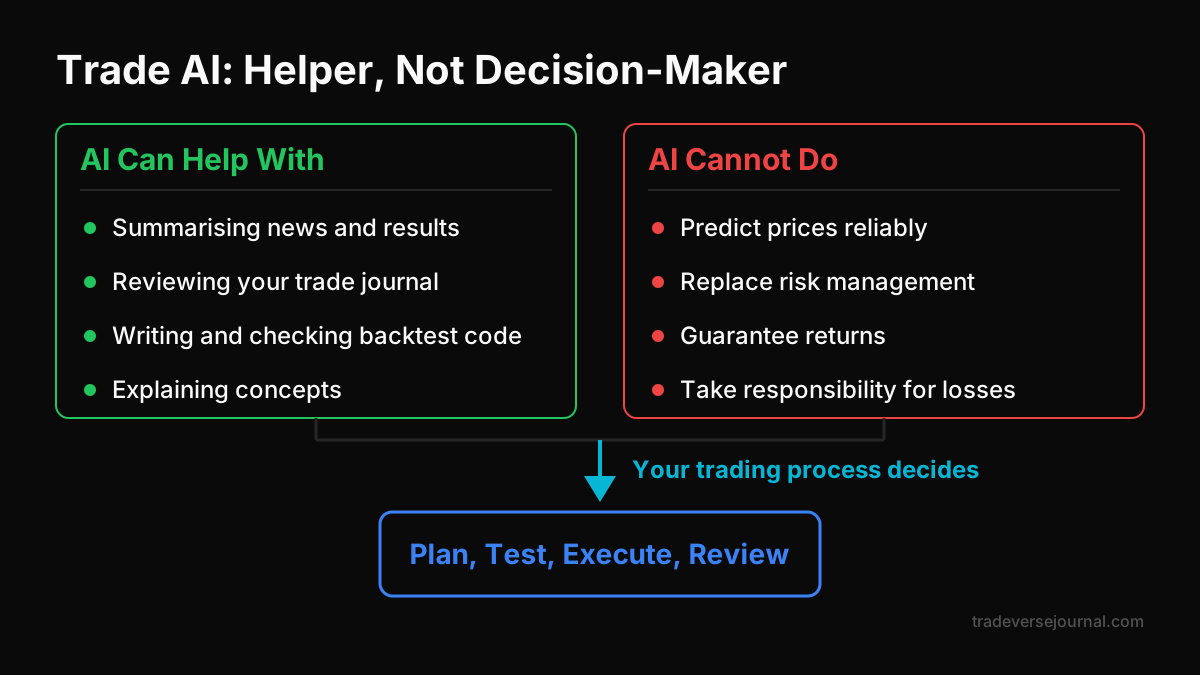
Table of Contents
- What Does Trade AI Mean?
- What Trade AI Can Realistically Do
- What Trade AI Cannot Do
- How to Use Trade AI Inside a Process
- Common Mistakes When Using AI for Trading
- Limitations of AI in Trading
- Red Flags in AI Trading Products
- FAQs
- Key Takeaways
- Related Articles
What Does Trade AI Mean?
When traders search for trade AI, they usually mean one of three very different things. Some want a tool that tells them what to buy. Some want a chatbot that helps with research. Others want a bot that places orders automatically.
These three categories carry very different levels of risk. Knowing which one you are dealing with is the first filter.
AI signals vs AI assistants vs trading bots
| Type | What it does | Typical use | Main risk |
|---|---|---|---|
| AI signal services | Sends buy or sell calls | "Buy XYZ above 500, target 540" alerts | Black-box logic, often from unregistered sellers |
| AI assistants | Answers questions, summarises, writes code | Summarise an earnings call, draft a backtest script | Confident but wrong answers |
| AI trading bots | Places orders through a broker API | Executes a fixed rule-based strategy | Runaway losses, compliance issues |
An AI assistant works for you and leaves the decision with you. A signal service or bot takes some of that decision away, which is why it needs far more scrutiny.
Why the search term is ambiguous
People type the query in many ways, such as "trade a i", "AI trading" or "AI stock picker". The phrase also overlaps with app names and brand names, so search results mix genuine tools, education and outright scams.
That mix is why you should judge a product by what it actually does, not by the label on it. A spreadsheet with a few if-then rules can be marketed as "AI" just as easily as a real machine learning model.
What Trade AI Can Realistically Do
The honest value of trade AI is in saving time and improving review, not in finding secret edges. The most useful ai trading tools handle the slow, repetitive parts of a trader's week.
Research and summarising news
A general-purpose AI assistant can turn a 40-page annual report or a long earnings call transcript into a one-page summary. You can ask it to list management guidance, debt changes or risks mentioned.
This is where AI for stock trading is genuinely helpful. It speeds up the reading, but you still need to verify key numbers against the original filing, because AI tools sometimes misquote figures.
Journal review and pattern spotting
If you keep a detailed trading journal with setups, emotions and outcomes, AI can help you find patterns you might miss. Export a few weeks of trades and ask it to group results by setup, time of day or day of week.
Common discoveries include:
- Losses clustered in the first 15 minutes after the open
- Bigger position sizes right after a losing trade
- One setup quietly carrying the whole month's results
Code and backtest help
AI assistants can draft Python or spreadsheet formulas to test a simple rule, such as "buy when the 20-day average crosses above the 50-day average". They can also help explain an error message or clean messy data.
Treat the code as a first draft. Read it line by line, check that it does not peek at future data, and follow a proper backtesting process for your strategies before trusting any result.
What Trade AI Cannot Do
This is where most disappointment comes from. Understanding the limits protects your capital more than any tool does.
Predicting prices
The question traders ask most is: can AI predict stocks? Not reliably. Prices react to news, order flow and crowd behaviour that no model fully captures. Any small statistical edge that does exist tends to shrink once many people use it.
Large institutions with huge datasets and research teams still have losing periods. A retail app claiming to forecast tomorrow's close with high accuracy should make you more cautious, not less.
Replacing risk management
No model removes the need for position sizing, stop-losses and daily loss limits. If a bot risks 10% of your account per trade, one bad streak can wipe out months of gains, however clever its entries are.
Your risk rules belong in your written trading plan, and any AI tool should operate inside those limits, not outside them.
Overfitting and false confidence
Overfitting happens when a strategy is tuned so tightly to past data that it fits noise instead of a real pattern. AI makes overfitting easier, because you can test hundreds of variations in minutes.
A backtest that shows a 90% win rate over two years is often a warning sign. Real, robust strategies usually look less impressive on paper and hold up better in live markets.
How to Use Trade AI Inside a Process
The safest way to use trade AI is as an assistant at specific points in your routine: research before the trade, review after it. The decision to enter, size and exit should stay rule-based and yours.
A worked example: reviewing a week of trades
Imagine a swing trader with an illustrative capital of ₹2,00,000 who risks 1% per trade, or ₹2,000 (1R). Over one week, they log 12 trades and ask an AI assistant to group them by setup and calculate results in R-multiples.
A useful prompt might look like this:
- "Here are my 12 trades with setup, entry, exit, size and notes."
- "Group them by setup and by whether they followed my plan."
- "Show total R for each group and point out any repeated behaviour."
The AI returns this summary (illustrative numbers):
| Group | Trades | Wins | Total R | Approx. P&L |
|---|---|---|---|---|
| Breakout setup | 5 | 3 | +4.0R | +₹8,000 |
| Reversal setup | 4 | 1 | -1.0R | -₹2,000 |
| Unplanned trades after a loss | 3 | 0 | -4.5R | -₹9,000 |
| Week total | 12 | 4 | -1.5R | -₹3,000 |
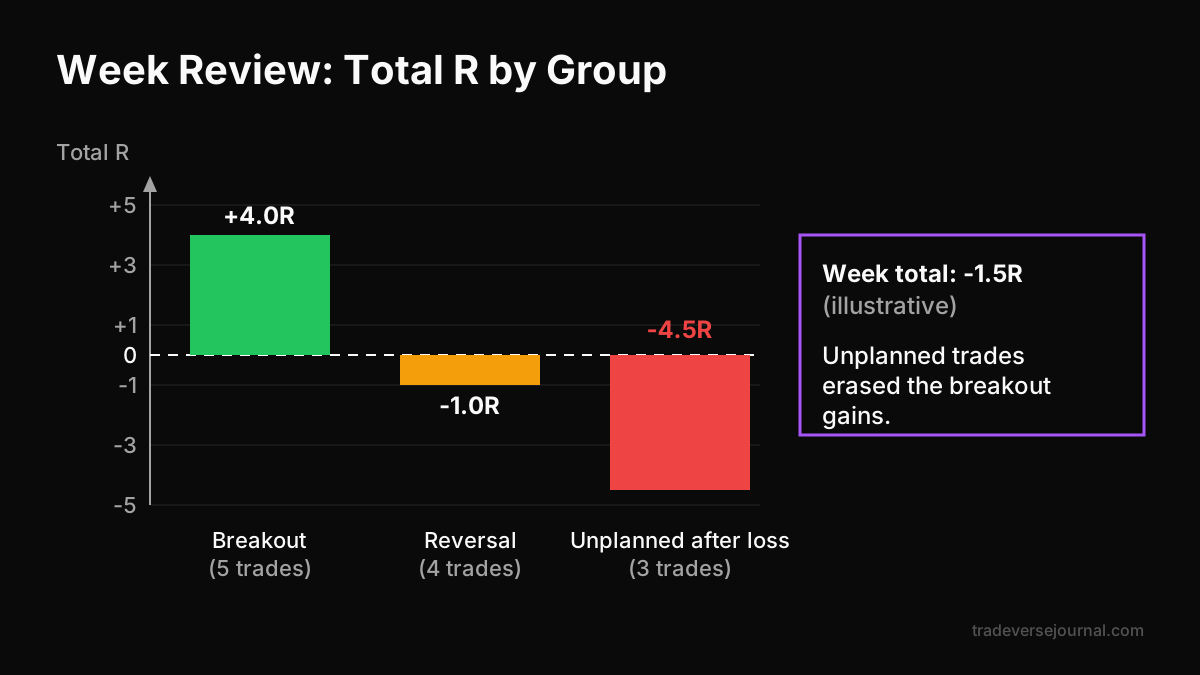
The insight is not a prediction. It shows that the breakout setup worked while three unplanned trades, taken at larger size after losses, erased those gains. The fix is a behavioural rule, such as "no new trades for 30 minutes after a loss", not a new indicator.
If you want to build this review habit hands-on rather than just reading about it, you can practise risk sizing and post-trade review step by step in Tradeverse Academy.
Validating any idea with a backtest
Whenever AI suggests a pattern or rule, run it through a simple checklist before risking money:
- Write the rule in plain words with exact entry, exit and stop conditions
- Get clean historical data from a reliable source, such as data published by the National Stock Exchange
- Test on one period, then check it on a separate period the rule has never seen
- Include brokerage, STT, slippage and other costs
- Paper trade or trade very small size for several weeks before scaling up
If the edge disappears once costs and new data are added, drop the idea. That is the process working, not failing.
Common Mistakes When Using AI for Trading
Most problems come from how traders use AI, not from the technology itself. Watch out for these:
- Copying outputs blindly: taking an AI-generated trade idea without checking the chart, news or your plan
- Asking for predictions: prompts like "Will Nifty go up tomorrow?" produce confident-sounding guesses, not analysis
- Skipping verification: trusting numbers from a summary without checking the original filing
- Scaling too fast: moving from backtest straight to full size without a live trial
- Buying expensive "AI" courses or bots: paying for a black box instead of learning the underlying skill
Many of these overlap with classic retail trading mistakes and how to fix them. AI simply lets you make them faster.
Limitations of AI in Trading
Even the best tools have structural limits you should keep in mind:
- Outdated knowledge: many AI assistants do not have live market data and may describe old prices or rules
- Hallucinations: AI can invent statistics, quotes or even regulations that sound real
- No accountability: an AI tool does not bear your losses or follow your risk limits on its own
- Regime changes: patterns learned in a trending market can fail in a sideways or high-volatility one
- Costs and execution: backtests often ignore slippage, gaps and liquidity, especially in F&O and smaller stocks
Use trade AI where these limits matter least: summarising, organising and reviewing. Be most careful where they matter most: live execution and money management.
Red Flags in AI Trading Products
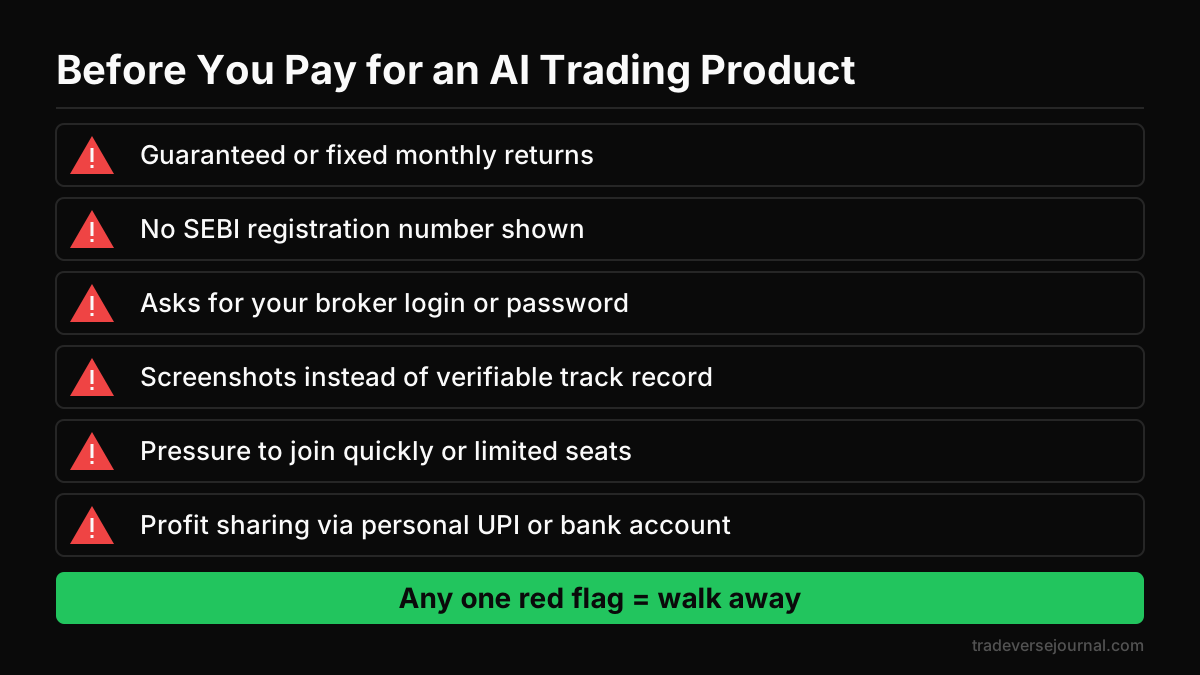
The "AI" label is now common in Telegram groups, apps and paid communities. Some offerings are genuine tools; many are repackaged tip services.
Guaranteed returns claims
No legitimate product can promise "3% a month" or "90% accuracy" in live markets. Claims like these, especially backed only by screenshots, are a classic warning sign.
Some schemes also use coordinated groups to pump small stocks while "AI" calls attract buyers. Learn how these traps work in this guide to spotting market manipulation.
Unregistered advice and SEBI considerations
In India, anyone giving paid investment advice or research recommendations generally needs to be registered with SEBI as an Investment Adviser or Research Analyst. A product sending buy or sell calls for a fee is giving advice, whether or not it calls itself AI.
For AI trading bots in India, SEBI has introduced a framework for retail algorithmic trading through brokers, with requirements around broker oversight and exchange approval of algos. Rules evolve, so check the latest SEBI circulars and your broker's policy, and never share your trading password with a third-party bot.
FAQs
Can AI predict the stock market?
No tool can predict the stock market reliably. AI can find statistical tendencies in past data, but markets react to news, sentiment and events that models cannot fully anticipate. Any edge tends to fade as more traders use it. Treat AI forecasts as ideas to test with a proper backtest, never as certainties to trade on.
Are AI trading bots legal in India?
Automated trading is permitted in India when it runs through a registered broker under SEBI and exchange rules. SEBI has set out a framework for retail algo trading that places responsibility on brokers and requires algos to be approved. Paid tip services calling themselves bots still need proper registration. Always check current SEBI circulars before using any bot.
Is trade AI safe for beginners?
Using AI to learn concepts, summarise news or review your journal is low risk and can be very helpful. Handing your money to an AI bot or signal service as a beginner is high risk. Learn the basics of risk management and build a written plan first, then use AI as an assistant inside that process.
Which AI tools help with trading research?
General AI assistants are useful for summarising annual reports, earnings calls and news, and for drafting backtest code. Charting platforms and journals increasingly add AI features for screening and trade review. Whatever you use, verify key numbers against original sources such as exchange filings, because AI tools can misquote figures or rely on outdated information.
Key Takeaways
- Trade AI covers three different things: assistants, signal services and bots, each with a different risk level.
- AI is most useful for research, summarising and reviewing your own trading journal.
- No AI tool can reliably predict prices or replace position sizing and stop-losses.
- Validate every AI-generated idea with an out-of-sample backtest that includes costs.
- Your biggest gains from AI often come from spotting behavioural leaks, not finding new entries.
- Avoid any product promising fixed returns or offering paid calls without SEBI registration.
Related Articles
- Backtesting Strategies Explained: Complete Guide for Traders
- Building a Trading Plan: Complete Step-by-Step Guide for Traders
- Trading Journals Explained: Complete Guide to Improve Trading Performance
- Retail Trading Mistakes Explained: 25 Costly Errors and How to Fix Them
- Market Manipulation Explained: How Traders Spot and Avoid Traps
Analyze Your Own Trades with Tradeverse Journal
The most advanced AI-powered trading journal and backtesting software.
Start Free Trial👉 Read next:
Backtesting Strategies: A Trader's Guide