Tradezella Review: Features, Pricing and Alternatives
Tradezella review for Indian traders: what the journal does, where it falls short for NSE F&O and crypto, and alternatives to weigh before you pay.
Quick Answer
Tradezella is a paid trading journal built in the US. It offers automated trade imports, performance analytics, trade replay and playbooks. For Indian traders it can suit simple equity or intraday trades. Before paying, check three things: whether your Indian broker's file imports cleanly, how multi-leg NSE F&O positions are grouped, and whether a dollar-billed subscription fits your budget. If any of these fail, a free spreadsheet or an India-focused journal app may serve you better.
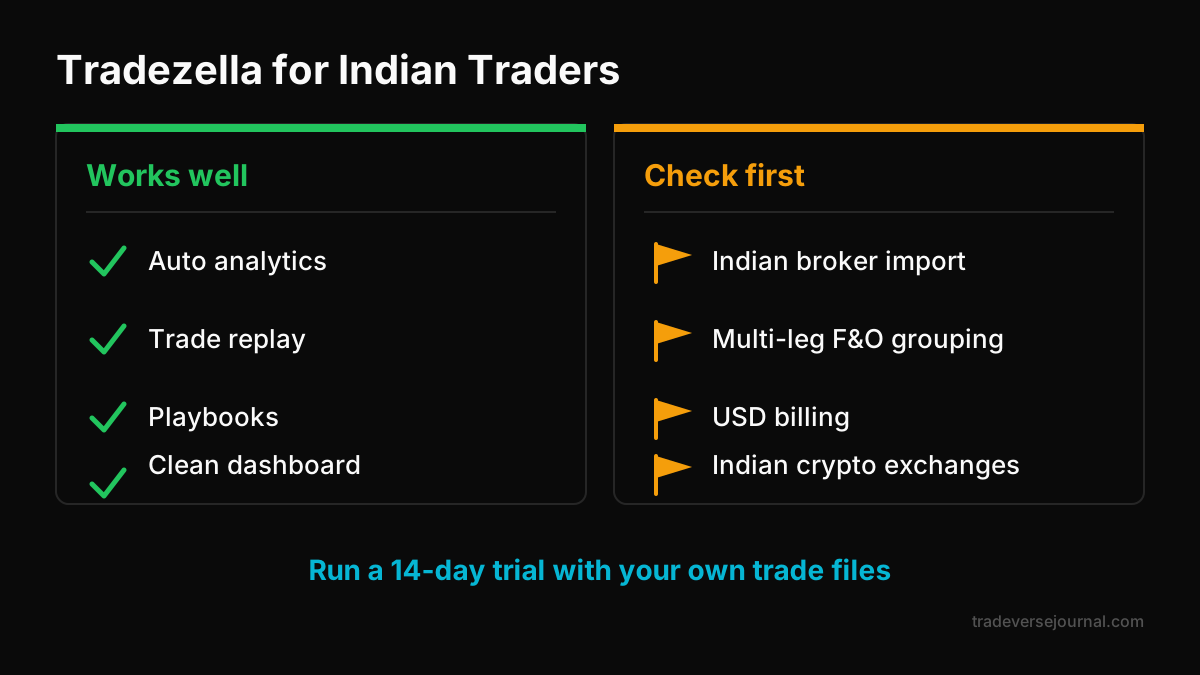
Table of Contents
- What Is Tradezella?
- Tradezella Review: What Works for Indian Traders
- Where Tradezella Falls Short
- Worked Example: One Nifty Iron Condor, Two Ways
- Tradezella Alternatives
- How to Choose a Journal You Will Actually Use
- Common Mistakes When Picking a Trading Journal
- Limitations of This Review
- FAQs
- Key Takeaways
- Related Articles
What Is Tradezella?
Tradezella is a cloud-based trading journal. You import your trades and it turns them into stats, charts and review tools. The idea is simple: stop guessing why your month went badly and let the data show you.
If you are new to journaling in general, our guide to how trading journals improve performance covers the basics before you compare tools.
Core features in plain terms
Feature names change over time, but the core toolkit generally looks like this:
- Imports: automatic sync for supported brokers, plus file uploads for others.
- Dashboard: net P&L, win rate, average win vs average loss and profit factor.
- Reports: results broken down by day, time, symbol, setup or tag.
- Trade replay: step through a chart of how a trade unfolded.
- Playbooks: written rules for each setup, so you can see which setups actually pay.
- Notebook: daily notes and pre-market plans next to your trades.
Who it is built for
The product is mainly designed for US stock, options, futures and forex traders, including prop-firm traders. That shows in the default brokers, the currency and the contract types it handles best.
That does not rule out Indian traders. It just means you should test the tool against your own workflow rather than rely on someone else's review.
Tradezella Review: What Works for Indian Traders
This Tradezella review looks at the tool through an Indian lens: Zerodha-style contract notes, weekly Nifty expiries and rupee P&L.
Trade import and broker support
Most searches for "tradezella india" come down to one question: will my broker work? Check the current supported-broker list on the official site. If your broker is not listed, you will usually need a generic CSV upload and some column mapping.
For a plain cash-market or single-leg intraday trader, a cleaned CSV often works fine. Expect some setup time on the first import, and recheck it whenever your broker changes its export format.
Analytics and reports
This is where the tool is genuinely strong. Once your trades are in, the reports answer practical questions quickly:
- Do your morning trades outperform afternoon ones?
- Is one setup quietly losing money while another carries you?
- Are your losers bigger than your winners?
For a trader who has never looked at a breakdown by time of day, this alone can change how they trade.
Replay and playbooks
Replay helps you review execution: where you entered, where you hesitated and where you cut early. Playbooks push you to define setups clearly, which is a skill in itself.
Both tools reward the effort you put in. If you never tag trades with a setup, the playbook reports stay empty.
Where Tradezella Falls Short
No journal fits every market. These are the gaps Indian traders most often hit.
NSE F&O and multi-leg strategies
Indian F&O volume is heavily options-driven, and many retail traders run spreads, straddles and iron condors on index weeklies. A journal that treats each leg as a separate trade can distort your stats, as the worked example below shows.
Before committing, upload one multi-leg trade and check whether it can be grouped as a single position. Contract specifications such as lot sizes and expiries are published by the exchange, so cross-check your imported quantities against NSE.
Pricing in rupees and currency issues
Subscriptions are billed in US dollars. That brings a few practical issues:
- The rupee cost moves with the exchange rate.
- Your card may add a foreign transaction markup.
- International recurring payments on Indian cards sometimes need extra authorisation.
Also check whether reports display rupee P&L correctly. Charges such as STT, stamp duty and exchange fees need to be included in your net figures.
Crypto exchange coverage
If you trade crypto on Indian exchanges, check coverage carefully. Global exchanges are more likely to be supported than local ones, which may leave you on manual CSV work. Our crypto trading journal guide covers what to look for in that case.
Worked Example: One Nifty Iron Condor, Two Ways
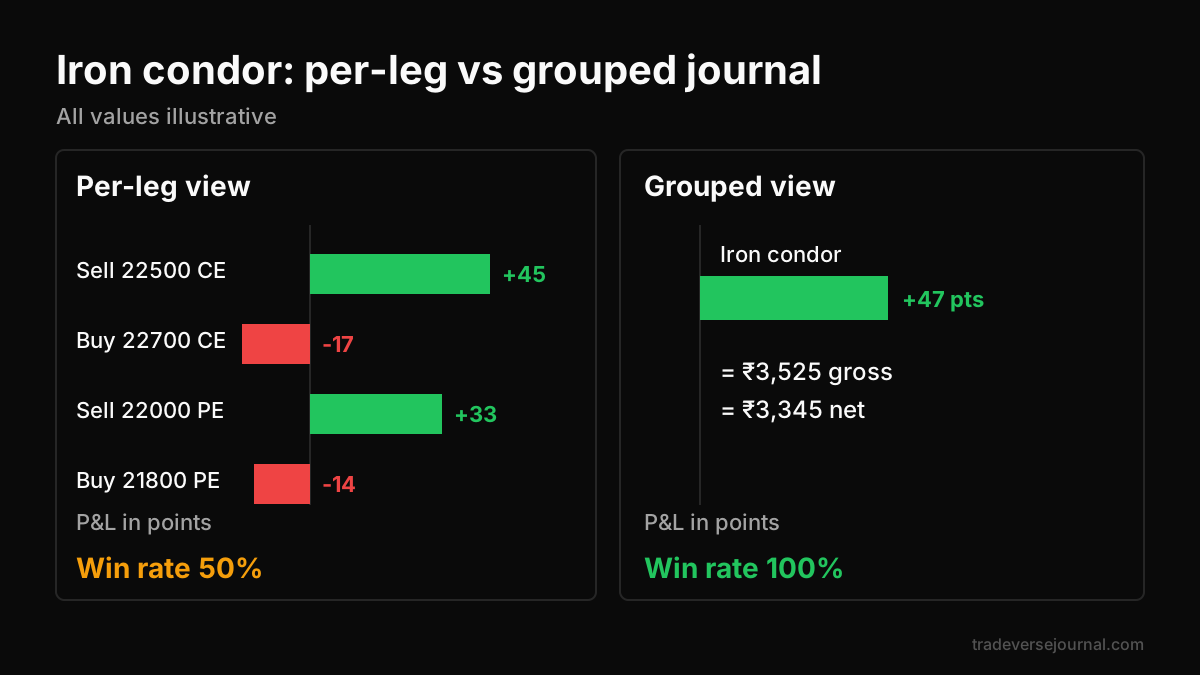
Here is an illustrative Nifty iron condor. The lot size is 75 for illustration only, and all prices are hypothetical.
| Leg | Entry (pts) | Exit (pts) | Leg P&L (pts) |
|---|---|---|---|
| Sell 22,500 CE | 60 | 15 | +45 |
| Buy 22,700 CE | 20 | 3 | -17 |
| Sell 22,000 PE | 55 | 22 | +33 |
| Buy 21,800 PE | 18 | 4 | -14 |
| Net | +47 |
The net result is 47 points × 75 = ₹3,525 before charges. Assume ₹180 in illustrative brokerage and taxes, which leaves ₹3,345 net.
Now look at how a journal reports it:
- Per-leg view: four trades, two winners and two losers, a 50% win rate. The two hedges look like "bad trades".
- Strategy view: one trade, one winner, a 100% win rate for this setup, and the hedges correctly read as protection.
Over a month of condors, the per-leg view could push you to drop your hedges. That is the opposite of a sensible lesson.
Tradezella Alternatives
Good Tradezella alternatives fall into two groups. Which one fits depends on your trade count and complexity.
Spreadsheet or free journal
A spreadsheet costs nothing and handles any instrument you want, including multi-leg F&O, because you define the rows. The trade-off is manual entry and no automatic charts unless you build them.
Start with our 12-field trading journal template, or follow the steps in building and reviewing a free trading journal.
Dedicated journaling apps
The tradezella vs journal app question is really about fit. A global app may have polished analytics, while an India-focused app (Tradeverse Journal is one; we publish it) is designed around Indian brokers, rupee P&L and F&O structures. Judge either on your own data, not on marketing pages.
Our checklist of features to check in a trading journal app helps you shortlist.
How to compare tools
| Criteria | Spreadsheet | Tradezella | India-focused journal app |
|---|---|---|---|
| Cost | Free | USD subscription | Varies, often INR pricing |
| Indian broker import | Manual | Check list or CSV | Usually built in |
| Multi-leg F&O grouping | You design it | Test before paying | Check support |
| Analytics depth | Basic unless built | Strong | Varies |
| Setup effort | High | Medium | Low to medium |
How to Choose a Journal You Will Actually Use
The best journal is the one you open every trading day. Features matter less than friction.
Checklist before paying
- Does a real contract note or tradebook from your broker import without errors?
- Are multi-leg positions grouped correctly?
- Is net P&L shown after Indian charges?
- Is the billing currency acceptable, and does your card accept recurring payments?
- Can you export your data if you leave?
- Does it cover every market you trade: equity, F&O and crypto?
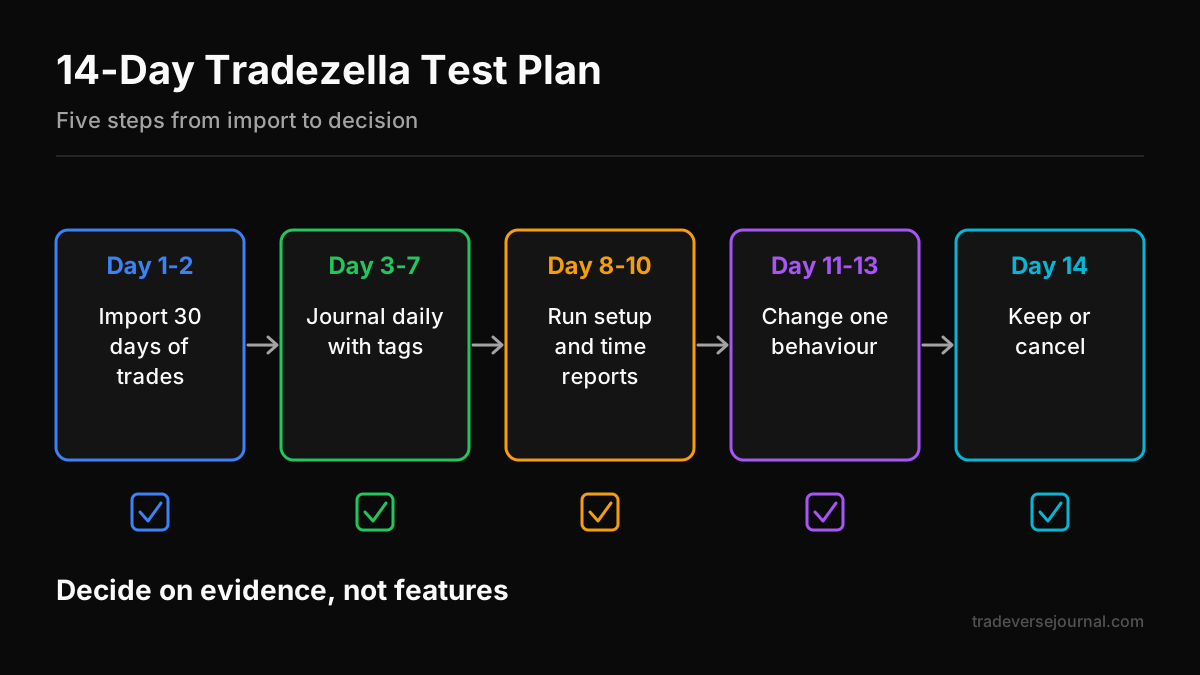
A 14-day trial routine
Use any free trial deliberately instead of just clicking around:
- Days 1-2: import the last 30 days of real trades and fix any mapping errors.
- Days 3-7: journal every new trade the same day, with setup tags and one line of notes.
- Days 8-10: run reports by setup and by time of day, and write down one finding.
- Days 11-13: change one behaviour based on that finding.
- Day 14: decide. Did the tool save time and surface something you did not already know?
If reading reports and turning them into rules feels new, you can practise the review process hands-on in Tradeverse Academy before you choose a paid tool.
Common Mistakes When Picking a Trading Journal
- Buying on features alone. Replay is useless if you never review trades.
- Testing with fake data. Always import your own messy broker files.
- Ignoring charges. Gross P&L flatters F&O traders, especially frequent scalpers.
- Logging hedges as separate trades. It skews win rate and setup stats.
- Switching tools monthly. Stats only become useful once you have a few months of consistent data.
- Skipping notes. Numbers show what happened, but notes explain why.
Limitations of This Review
Treat this article as a framework rather than a final verdict. Features, broker integrations and pricing change, so check the official site for current details.
We have not tested every Indian broker's export format. We also publish a competing journal, which is why we suggest judging any tool, including ours, on your own trade data. Nothing here is investment advice. SEBI's investor resources on sebi.gov.in are worth reading on F&O risk.
FAQs
Is Tradezella worth it for Indian traders?
It can be, if you trade simple equity or single-leg setups and value deep analytics. It is less clear-cut for multi-leg F&O traders or anyone on a tight budget, given USD billing. Run a two-week trial with real broker files and judge it on whether it saves time and reveals useful patterns.
Does Tradezella support Indian brokers?
Support changes over time, so check the current broker list on the official site. If your broker is not listed, you can usually upload a CSV and map the columns manually. Test with a real tradebook or contract note first, and confirm that quantities, prices and charges come through accurately.
Is there a free alternative to Tradezella?
Yes. A well-structured spreadsheet is free and flexible, and handles any instrument, including multi-leg options. It needs manual entry and some setup for charts. Some journal apps also offer free tiers. Start with a template that tracks setup, entry, exit, size, charges and notes for every trade.
Can I journal F&O trades in Tradezella?
You can log options and futures, but check how it handles NSE multi-leg strategies before paying. If each leg appears as a separate trade, your win rate and setup stats can be misleading. Import one spread or iron condor during the trial and see whether it can be grouped as a single position.
Key Takeaways
- Tradezella offers strong analytics, replay and playbooks, but it is built primarily for US markets.
- Test Indian broker imports with your own files before paying.
- Multi-leg F&O trades must be grouped, or your stats will mislead you.
- USD billing means a variable rupee cost and possible card friction.
- Spreadsheets and India-focused journal apps are realistic alternatives.
- Use a structured 14-day trial and decide on evidence, not feature lists.
Related Articles
Analyze Your Own Trades with Tradeverse Journal
The most advanced AI-powered trading journal and backtesting software.
Start Free Trial