Trade Diary: How to Keep One and Review It Weekly
Trade diary guide for Indian traders: what to write before and after each trade, a simple format, and a weekly review routine. Start yours today.
Quick Answer
A trade diary is a written record of every trade you take: why you entered, how much you risked, what you felt and what you learned. To keep one, log each trade in three parts (before, during, after), keep the fields few, and review the entries every weekend. Tag repeated mistakes, count them, and change one rule per week. Over time, the diary shows you patterns that memory hides.
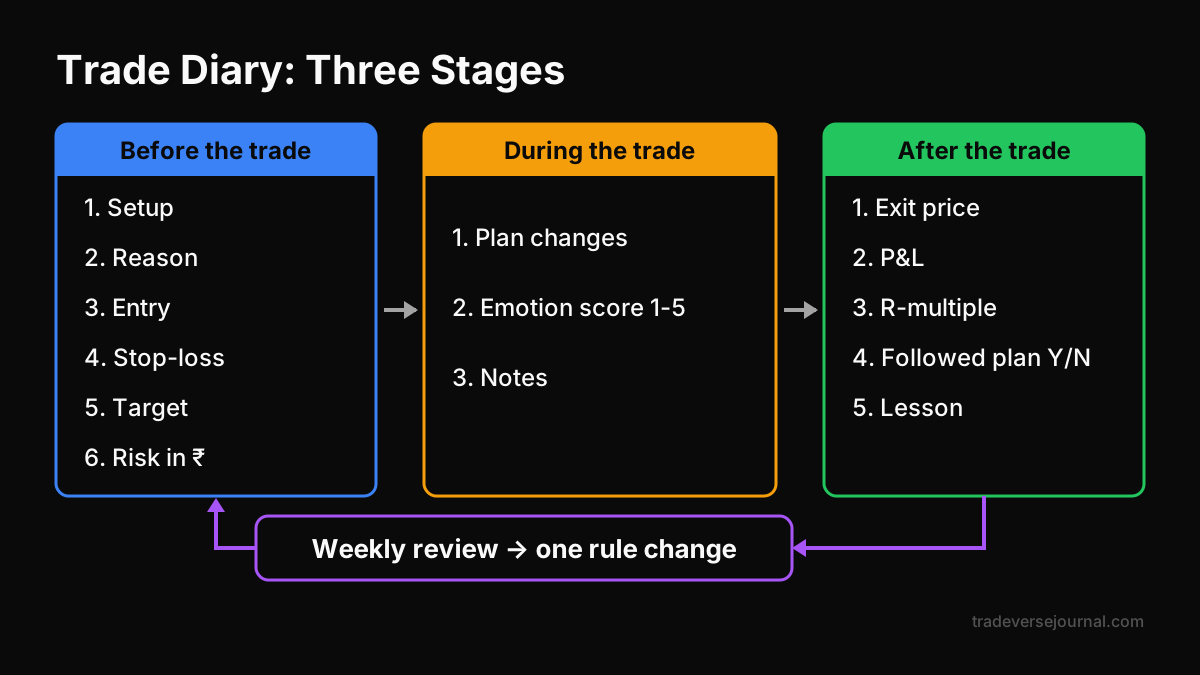
Table of Contents
- What Is a Trade Diary?
- What to Write in Your Trade Diary
- A Simple Trade Diary Format
- How to Review Your Trade Diary Weekly
- Common Trade Diary Mistakes
- Limitations to Keep in Mind
- FAQs
- Key Takeaways
- Related Articles
What Is a Trade Diary?
It is a notebook where your trading process lives. Every time you place a trade, you write down what you planned, what actually happened and what you would do differently.
Some traders call it a trading diary, others a trade log. The name matters less than the habit. The goal is to replace "I think I usually do well on expiry days" with "I took 14 expiry-day trades this month and broke my stop on 6 of them."
Trade diary vs trading journal
The two terms overlap, and many traders use them interchangeably. When people separate them, a journal usually means the full system: trade data, statistics, equity curve, win rate and charts.
The diary is the narrative part of that system. It holds the reasons, emotions and lessons, written in your own words. If you want the full picture of what a complete journal includes, see our guide to trading journals and how they improve performance.
| Aspect | Diary | Journal (full system) |
|---|---|---|
| Main focus | Reasons, emotions, lessons | Numbers, stats, performance |
| Format | Short written notes | Structured fields and reports |
| Best for | Understanding behaviour | Measuring results |
| Time per trade | 2-3 minutes | Varies with tools |
Why a diary beats memory
Memory is a poor record keeper for traders. After a loss, the brain quietly edits the story: "the market was manipulated" or "I was just unlucky." After a win, it remembers skill, not the rule you broke to get there.
A written note made at the time of the trade cannot be edited by hindsight. When you read it a week later, you see what you actually thought, not what you now wish you had thought.
What to Write in Your Trade Diary
If you are wondering how to maintain a trade diary without it becoming a chore, split every entry into three moments. Each one takes a minute or two.
Before the trade: setup, reason, risk
Write this part before you click buy or sell. If you cannot fill it in, you probably should not take the trade.
- Instrument and direction: for example, Nifty futures, long
- Setup name: breakout, pullback to support, range reversal
- Reason in one sentence: what you see on the chart that makes this a valid setup
- Entry, stop-loss and target: exact levels, not "around"
- Risk in rupees: how much you lose if the stop is hit
For F&O trades, confirm lot sizes and contract details on NSE before sizing. Lot sizes change from time to time, and a wrong lot size quietly doubles or halves your real risk.
During the trade: plan changes and emotions
Most traders skip this part, yet it is often the most revealing. Note anything you change while the trade is open, and why.
- Did you move your stop-loss? Wider or tighter?
- Did you add to the position or exit part of it?
- Emotion score: rate yourself 1 (calm) to 5 (panicked or overexcited)
- One line on what you were feeling: fear of giving back profit, urge to recover a loss, boredom
These notes connect your actions to your state of mind. Our guide to trading psychology for consistent traders explains the common emotional traps that tend to show up here.
After the trade: outcome and lesson
Fill this in as soon as the trade closes, while the details are still fresh.
- Exit price and reason for exit
- Profit or loss in rupees and in R (multiples of your planned risk)
- Followed plan: Yes or No
- One lesson, written as an instruction to your future self
Keep the lesson specific. "Be more disciplined" is useless. "Do not exit before target unless price closes below the 15-minute swing low" is something you can actually follow.
A Simple Trade Diary Format
You do not need a complicated template. The format below fits on one row of a spreadsheet or half a notebook page. For a more detailed field list, our trading journal template with 12 fields builds on the same idea.
| Field | What to write |
|---|---|
| Date and time | Entry time, so you can spot time-of-day patterns |
| Instrument | Stock, index, option strike or crypto pair |
| Setup | Name of the setup from your playbook |
| Reason | One sentence |
| Entry / Stop / Target | Exact levels |
| Risk (₹) | Maximum planned loss |
| Plan changes | Anything changed mid-trade |
| Emotion (1-5) | Your state during the trade |
| Exit and P&L | Price, rupees, R-multiple |
| Followed plan | Yes / No |
| Lesson | One actionable line |
Example entry for a Nifty trade
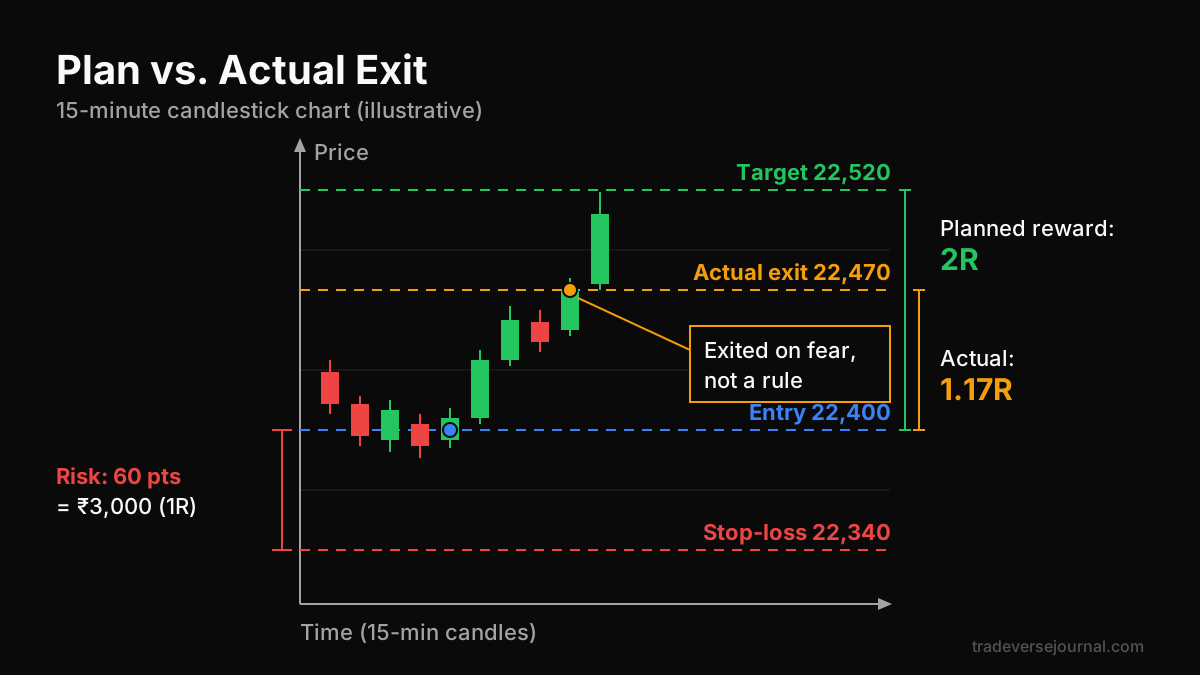
Here is a worked example with illustrative numbers. They are not real current prices. Assume a trading account of ₹3,00,000, a 1% risk rule and a lot size of 50 units for easy maths.
| Field | Entry |
|---|---|
| Instrument | Nifty futures, long, 1 lot |
| Setup | Pullback to previous breakout level |
| Reason | Price retested 22,400 after breakout and formed a higher low on the 15-min chart |
| Entry / Stop / Target | 22,400 / 22,340 / 22,520 |
| Risk (₹) | 60 points × 50 = ₹3,000 (1% of capital) |
| Plan changes | Exited early at 22,470 after a red candle |
| Emotion (1-5) | 4, worried about giving back open profit |
| Exit and P&L | 22,470, +70 points = +₹3,500, +1.17R |
| Followed plan | No |
| Lesson | Hold to target unless a 15-min candle closes below the last swing low |
The trade made money, but the diary tells a more useful story. The plan offered 2R (120 points of reward for 60 of risk). Fear cut it to 1.17R. Repeat that across 20 trades and the gap between planned and actual reward becomes large.
Writing a clean pre-trade plan like this takes practice. If you want to rehearse planning entries, stops and position size before putting money at risk, you can work through these steps hands-on in Tradeverse Academy's practice-based lessons.
Paper, Excel or app
Pick the tool you will actually use every day. Consistency matters far more than features.
| Option | Strengths | Weaknesses | Suits |
|---|---|---|---|
| Paper notebook | Fast, no distractions, good for emotions | Hard to filter or count | Beginners, few trades a week |
| Excel / Google Sheets | Free, sortable, easy to tag and count | Manual entry, needs discipline | Most retail traders |
| Journaling app | Auto-imports, charts, reports | Learning curve, may cost money | Active F&O and crypto traders |
If you search for trade diary excel templates, start with the simplest one you find and delete columns you will not use. Our guide on building a free trading journal for Indian traders walks through setting up a sheet from scratch.
How to Review Your Trade Diary Weekly
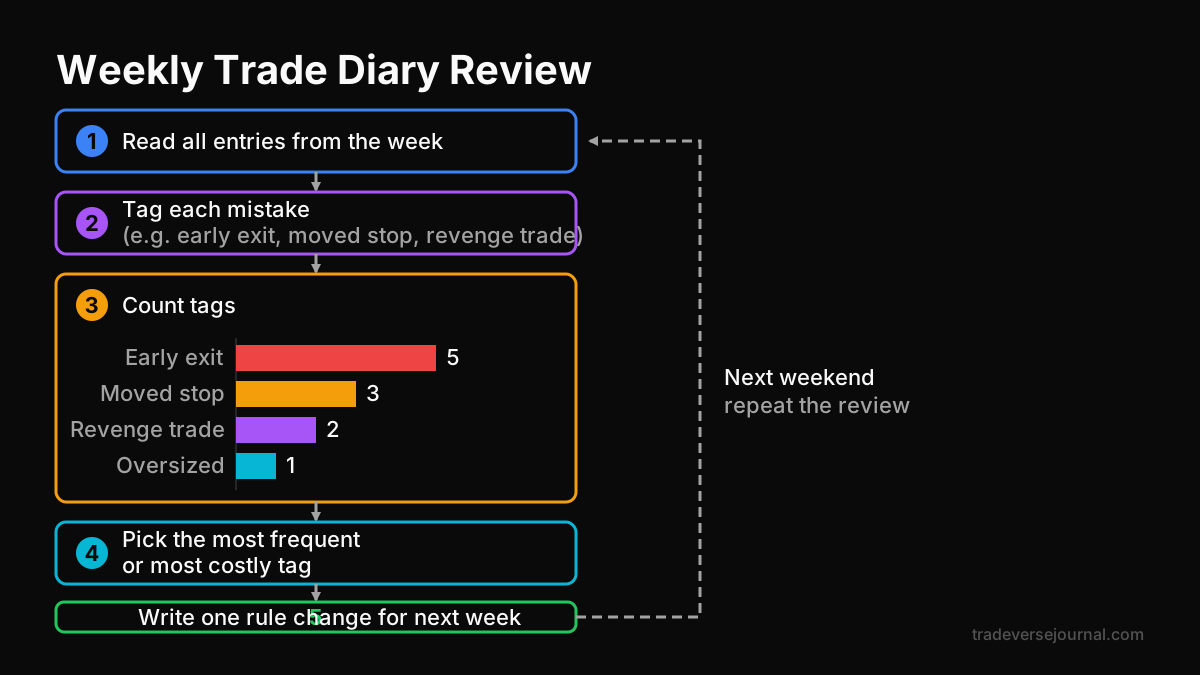
Writing entries is only half the job. The value comes from reading them back. Block 30-45 minutes every weekend, when markets are closed and you are not reacting to live prices.
Tag mistakes and find repeats
Go through every entry and add a short tag to any trade where you broke your plan. Use the same tags each week so you can count them.
- Early exit: closed before target without a rule-based reason
- Moved stop: widened stop-loss mid-trade
- Revenge trade: entered to recover a recent loss
- Oversized: risked more than your rule allows
- No setup: traded without a defined reason
Then count. A week might show five early exits, three moved stops and two revenge trades. Also add up the rupee cost of each tag. One revenge trade sometimes costs more than five early exits combined.
Turn findings into one rule change
Pick the single most frequent or most expensive mistake and write one rule to address it. Only one. Changing five things at once makes it impossible to tell what helped.
For the early-exit problem in the example, the rule might be: "Once in a trade, I only exit at stop, at target, or on a 15-minute close below the last swing low." Write it at the top of next week's page and check it off after each trade.
Common Trade Diary Mistakes
Most diaries fail not because traders lack discipline, but because the setup makes the habit hard to sustain. Here are the problems that show up most often. Our list of costly retail trading mistakes and how to fix them covers related errors in more depth.
Logging only winners
It feels good to write up a clean winning trade. It feels terrible to write up a revenge trade that blew through your stop. So the losers quietly disappear.
A diary with missing losses gives you a flattering and useless picture. Make a simple rule: if a trade appears in your broker's contract note, it goes in the diary. No exceptions.
Too many fields
Enthusiastic traders build a sheet with 30 columns: RSI value, VIX, moon phase, sleep hours. Within two weeks, logging takes longer than trading, and the diary is abandoned.
Start with eight to eleven fields like the format above. Add a new field only when your weekly review raises a specific question that the current fields cannot answer.
Writing entries hours later
Filling in the diary at night, from memory, brings back the hindsight problem you were trying to avoid. At minimum, write the "before" section before entry and the "after" section within an hour of exit.
Limitations to Keep in Mind
A trade diary cannot tell you whether a strategy has an edge. It records behaviour and outcomes, but a few weeks of entries are too small a sample to judge a system's long-term results.
- Small samples mislead: 10 trades can look great or terrible purely by chance
- Self-reported emotions are imperfect: you may underrate how anxious you were
- It does not replace risk rules: a diary records a blown stop; it cannot prevent one
- It takes time: expect a few minutes per trade, plus a weekly review
Treat the diary as a mirror for your process, not a prediction tool. It works best alongside clear risk management and a defined set of setups.
FAQs
What should I write in a trade diary?
Write your setup, a one-line reason, entry, stop-loss, target and rupee risk before the trade. During the trade, note any plan changes and an emotion score. After exit, record price, P&L, R-multiple, whether you followed the plan, and one specific lesson. Keep it short enough that you will do it for every single trade.
Is a trade diary the same as a trading journal?
The terms overlap and many traders use them interchangeably. When separated, a journal usually means the full system with statistics, equity curves and reports, while the diary is the written, narrative part covering reasons, emotions and lessons. Both serve the same purpose: making your trading process visible so you can improve it.
How often should I update my trade diary?
Update it with every trade, not at the end of the day. Write the plan before entry and the outcome within an hour of exit, while details are fresh. Then set aside 30-45 minutes each weekend to review the week's entries, tag mistakes, and choose one rule to change for the next week.
Can I use Excel as a trade diary?
Yes. Excel or Google Sheets works well for most retail traders because it is free, easy to sort, and lets you count mistake tags quickly. Keep one row per trade with around ten columns. Add a pivot table or simple COUNTIF formulas to see which mistakes repeat most often during your weekly review.
Key Takeaways
- Log every trade in three parts: before (plan), during (changes and emotions) and after (outcome and lesson).
- Write the plan before you enter; if you cannot fill it in, skip the trade.
- Start with eight to eleven fields and add more only when your review needs them.
- Record losing and rule-breaking trades, not just winners.
- Review weekly: tag mistakes, count them, and note their rupee cost.
- Change only one rule per week so you can see what actually helps.
- Use whichever tool you will stick with: paper, a spreadsheet or an app.
Related Articles
- Trading Journals Explained: Complete Guide to Improve Trading Performance
- Trading Journal Template: 12 Fields to Track Every Trade
- Free Trading Journal: How to Build and Review One (India)
- Trading Psychology Explained: Complete Guide for Consistent Traders
- Retail Trading Mistakes Explained: 25 Costly Errors and How to Fix Them
Analyze Your Own Trades with Tradeverse Journal
The most advanced AI-powered trading journal and backtesting software.
Start Free Trial👉 Read next:
Trading Journals: Improve Your Trading