Trading for Beginners: How to Start Right
Trading for beginners in India: trading vs investing, styles, the 1% risk rule, a 90-day plan and mistakes to avoid. Start the right way before risking money.
Quick Answer
Trading for beginners means learning to buy and sell stocks or other assets for short-term price moves while protecting your capital first. Start with a demat and trading account from a SEBI-registered broker, use only money you can afford to lose, and follow a written plan. Risk about 1% of capital per trade, practise on charts before going live, and ignore tips from unregistered people. This guide is education, not investment advice.
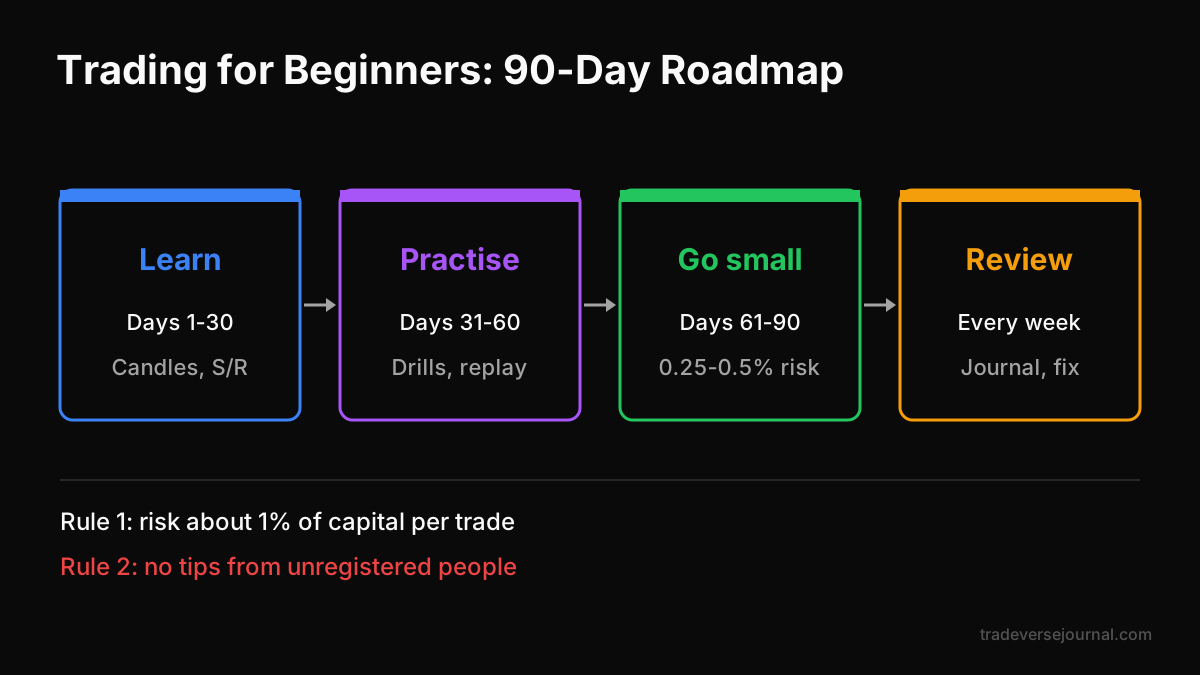
Table of Contents
- Trading for Beginners: Trading vs Investing
- Risk Rules and Your First 90 Days
- Common Mistakes
- Limitations of Learning to Trade
- Where to Practise: Tradeverse Academy
- FAQs
- Key Takeaways
- Related Articles
Trading for Beginners: Trading vs Investing
Trading and investing both involve buying assets, but the goals differ. An investor buys a business and holds it for years, betting on earnings growth. A trader holds for minutes, days or weeks, aiming to profit from a price move, and exits when the setup plays out, right or wrong.
That difference shapes everything about trading for beginners. Investors can sit through a bad quarter. Traders cannot, because a short holding period means every mistake shows up quickly in the account. Trading is a skill of managing risk under uncertainty, not of predicting the future.
Trading styles compared
In trading for beginners, most people start with one of three styles. Pick one based on your time, temperament and capital, not on what looks exciting on social media.
| Style | Holding period | Time needed | Main challenge | Good fit for |
|---|---|---|---|---|
| Intraday | Minutes to hours, closed the same day | Full attention in market hours | Speed, costs, emotional pressure | People who can watch screens all session |
| Swing | 2 days to a few weeks | 30-60 minutes a day | Overnight gaps, patience | Working professionals |
| Positional | Weeks to months | A few hours a week | Wider stops, slower feedback | Patient learners with a trend view |
For deeper reading, see our guides on intraday trading for Indian traders and swing trading. Many newcomers find swing or positional trading easier, because decisions happen after the close instead of inside a fast-moving session.
What you need: how to start trading
Here is how to start trading in India, the practical side of trading for beginners:
- A demat and trading account. The demat account holds your shares; the trading account places orders. Open them with a SEBI-registered broker that is a member of NSE or BSE. Well-known names include Zerodha, Groww, Angel One and Upstox, but compare platform stability, charges, order types and support yourself. You can check member details on the NSE website.
- Capital you can afford to lose. Only use money that would not hurt your rent, EMIs or emergency fund if it disappeared. For most people this is a small slice of savings.
- A written plan. Decide what you trade, which setups you take, how much you risk and when you stop for the day. Our guide to building a trading plan walks through a template.
Trading basics: core concepts
These trading basics come up in every single trade, so learn them before you place an order:
- Candlesticks and timeframes. Each candle shows the open, high, low and close for a period. The same stock looks different on a 5-minute and a daily chart.
- Support and resistance. Price zones where buying or selling has repeatedly appeared.
- Trend. A series of higher highs and higher lows (uptrend) or lower highs and lower lows (downtrend).
- Order types. Market, limit and stop-loss orders, and when each one makes sense.
- Stop loss. A pre-decided exit if the trade goes against you.
- Risk-reward. How much you stand to gain versus lose. Our risk reward ratio guide explains the maths.
- Costs. Brokerage, STT, exchange charges, GST and stamp duty all reduce returns, and they matter more the more often you trade.
Stock trading for beginners is mostly about these fundamentals done consistently, not about finding a secret indicator. Good trading for beginners looks boring from the outside.
Risk Rules and Your First 90 Days
Risk management is the part of trading for beginners that decides whether you survive long enough to improve. The most widely used rule is simple: risk no more than 1% of your trading capital on any single trade.
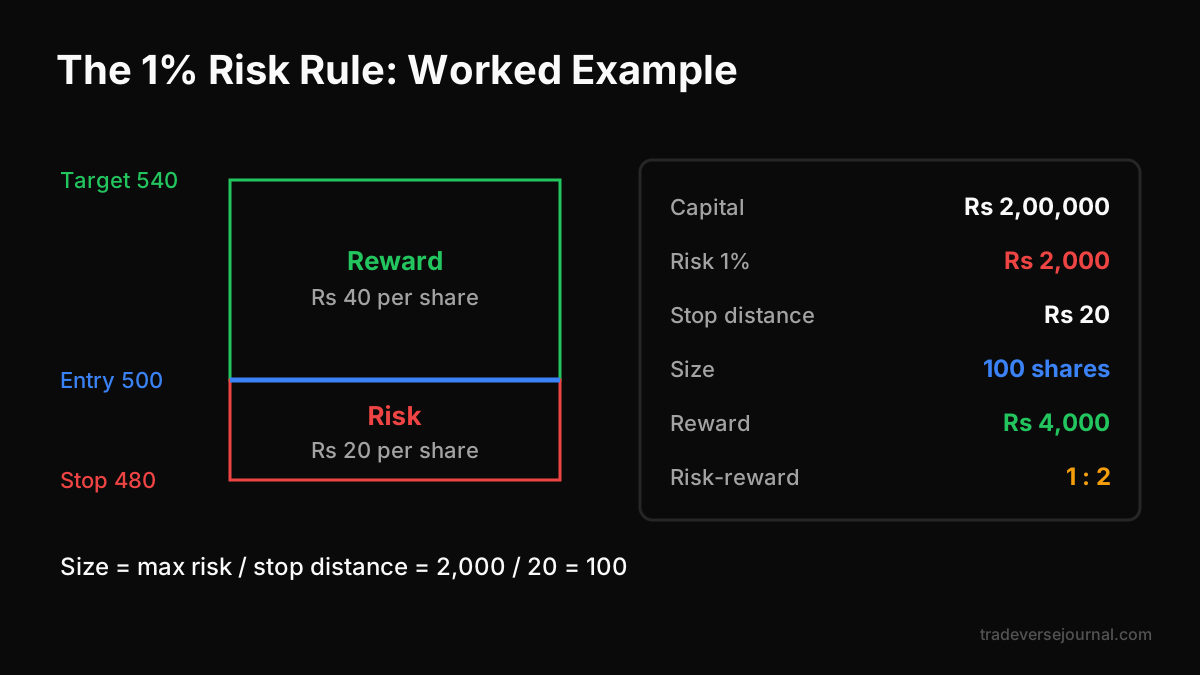
Worked example: the 1% rule
Assume these illustrative numbers:
- Trading capital: ₹2,00,000
- Maximum risk per trade (1%): ₹2,000
- Planned entry: ₹500
- Stop loss: ₹480
- Risk per share: ₹500 minus ₹480 = ₹20
- Position size: ₹2,000 divided by ₹20 = 100 shares
- Position value: 100 x ₹500 = ₹50,000
The position is worth ₹50,000, but the amount at risk is only ₹2,000. If the stop is hit, you lose about 1% of capital plus costs. Even ten losses in a row would leave roughly ₹1,80,000, which is a setback, not a disaster.
If your target is ₹540, the potential reward is ₹40 per share, or ₹4,000 in total. That is a 1:2 risk-reward. Our position sizing guide shows how to repeat this calculation for any trade, and the free Position Size Calculator in Tradeverse tools does it in seconds.
Three more risk rules worth adopting from day one:
- Set a daily loss limit, for example 3% of capital, and stop trading for the day once you hit it.
- Never move your stop loss further away once a trade is live.
- Stay away from leverage and F&O until you have a track record. A SEBI study found that 93% of individual F&O traders lost money between FY22 and FY24.
A first 90 days plan for trading for beginners
| Phase | Days | Focus | Output |
|---|---|---|---|
| Learn | 1-30 | Candles, support and resistance, trend, order types, costs | A one-page written plan |
| Practise | 31-60 | Chart drills, replay sessions, paper trades with full notes | 30+ practice trades reviewed |
| Go small | 61-90 | Live trades at 0.25-0.5% risk, one setup only | A journal entry for every trade |
In the first month, avoid live trading entirely. In the second, practise the exact setups in your plan and log every one. In the third, go live with a fraction of your normal size. The goal of the first 90 days of trading for beginners is a repeatable process, not profit.
Keep a trade diary from the very first practice trade. A journal turns random experiences into lessons you can act on.
Common Mistakes
These beginner trading mistakes show up again and again. Our longer list of retail trading mistakes covers 25 of them in detail. Avoiding them matters more in trading for beginners than finding a perfect strategy.
- Following tips from unregistered people. Telegram channels, WhatsApp groups, YouTube and Instagram "calls" are a red flag. Only SEBI-registered Investment Advisers (IA) and Research Analysts (RA) may give stock recommendations, and you can verify registration on the SEBI website. Guaranteed returns are always a warning sign.
- Trading too big. Risking 10% on one trade means a handful of losses can end your account.
- No stop loss. Hoping a losing trade comes back is how small losses become large ones.
- Jumping into F&O early. Options look cheap, but leverage and time decay punish newcomers.
- Overtrading. More trades mean more costs and more emotional decisions.
- Revenge trading. Trying to win back a loss immediately usually adds to it.
- Skipping the journal. Without records, you repeat the same errors without noticing.
Limitations of Learning to Trade
Be honest about what any guide on trading for beginners can and cannot do:
- No plan, course or rule guarantees profits. SEBI found that over 70% of individual intraday traders in the equity cash segment made losses in FY23.
- Practice is not the same as live trading. Paper trades do not carry the fear and greed that real money brings.
- Markets change. A setup that worked last year may work less well this year.
- Costs and taxes can turn a small edge into a net loss, especially for frequent traders.
- Some people will decide that active trading is not for them, and that is a valid outcome. Long-term investing remains an option.
This article is education, not investment advice. Nothing here is a recommendation to buy or sell any security.
Where to Practise: Tradeverse Academy
The fastest way to learn trading basics is to use them yourself, not just watch someone else. That is why we built Tradeverse Academy, our own learning app, around learning by doing. Its tagline sums up the approach: master trading one concept at a time.
Here is why it is a strong first step for trading for beginners:
- Active practice. In chart drills you mark levels on a real NIFTY chart yourself. In the Support & Resistance lesson, you are scored against what the market did next.
- Instant feedback. You find out whether your read was right immediately, instead of discovering it weeks later with real money.
- Short lessons. Lessons take about 5-12 minutes and earn XP, so learning fits into a busy day.
- Progress tracking. A daily streak, a daily warm-up question, XP history and a leaderboard help you stay consistent.
- Market Replay unit tests. You replay a real session bar by bar, name the pattern, place the stop and try to survive to the close. Passing unlocks the next unit.
You can start free with Candlestick Essentials, which covers the anatomy of a candlestick, timeframes, support and resistance, and trendlines. Premium courses such as How to Actually Trade (demat accounts, order types, brokerage and taxes, your first trade) and Risk & Trader Mindset (position sizing, stop-loss discipline, journaling) unlock with an upgrade.
Lessons use Indian markets, but the core skills they train, such as reading candles, sizing risk and staying disciplined, apply to any market, including crypto, which makes it a practical base for trading for beginners. To compare your options, read our guide to the best app to learn trading, then start practising in the Academy.
FAQs
How much money do I need to start trading?
There is no fixed minimum for trading for beginners. What matters is that the amount is money you can afford to lose without affecting rent, EMIs or your emergency fund. Starting small also keeps your rupee risk per trade low while you learn. Many people practise with charts and paper trades first, then go live with a modest amount once their process is consistent.
Is trading for beginners risky?
Yes. Trading carries real risk of loss, and SEBI data shows most individual intraday and F&O traders lose money. You reduce the damage by risking around 1% per trade, using a stop loss on every position, setting a daily loss limit and avoiding leverage early. Practising before you trade live also helps you make mistakes cheaply.
What is the difference between trading and investing?
Investing means buying assets, usually businesses, and holding them for years based on long-term growth. Trading means holding for minutes, days or weeks to profit from price movement, with a planned exit either way. Traders rely more on charts, risk rules and timing, while investors focus more on business quality and valuation over time.
Which trading style is best for beginners?
Swing or positional trading usually suits beginners better than intraday. Decisions can be made after market hours, there is less screen pressure and costs per month tend to be lower because you trade less often. Intraday trading demands full attention during the session and fast decisions, which is hard while you are still learning the basics.
Can I learn trading without losing money?
You can learn the skills without risking capital by using chart drills, replay sessions and paper trading. These build pattern recognition, stop placement and discipline. However, live trading adds emotions that practice cannot fully copy, so expect some losses when you start with real money. Keep size very small at first so those losses stay affordable.
Key Takeaways
- Trading is about managing risk on short-term price moves; investing is about owning businesses for years.
- Start with a demat and trading account from a SEBI-registered broker, capital you can afford to lose and a written plan.
- The core rule of trading for beginners: risk about 1% of capital per trade and size positions from your stop loss.
- Spend your first 90 days learning, practising and then trading very small.
- Never act on tips from unregistered people; only SEBI-registered IAs and RAs may recommend stocks.
- Practise on real charts with instant feedback before risking money.
Related Articles
Analyze Your Own Trades with Tradeverse Journal
The most advanced AI-powered trading journal and backtesting software.
Start Free Trial👉 Read next:
Intraday Trading Guide for Indian Traders