Best App to Learn Trading in India (2026)
Looking for the best app to learn trading? Compare YouTube, courses, books, paper trading and Tradeverse Academy, plus a 30-day plan to build real skill.
Quick Answer
The best app to learn trading is one that makes you practise on real charts, scores each decision you make and brings you back for a few minutes every day, instead of only playing videos. Judged that way, Tradeverse Academy is the best place to learn trading that we can point a beginner to: short lessons, chart drills on real NIFTY bars, Market Replay tests, XP and streaks. It teaches skills, not tips, and it is not a broker.
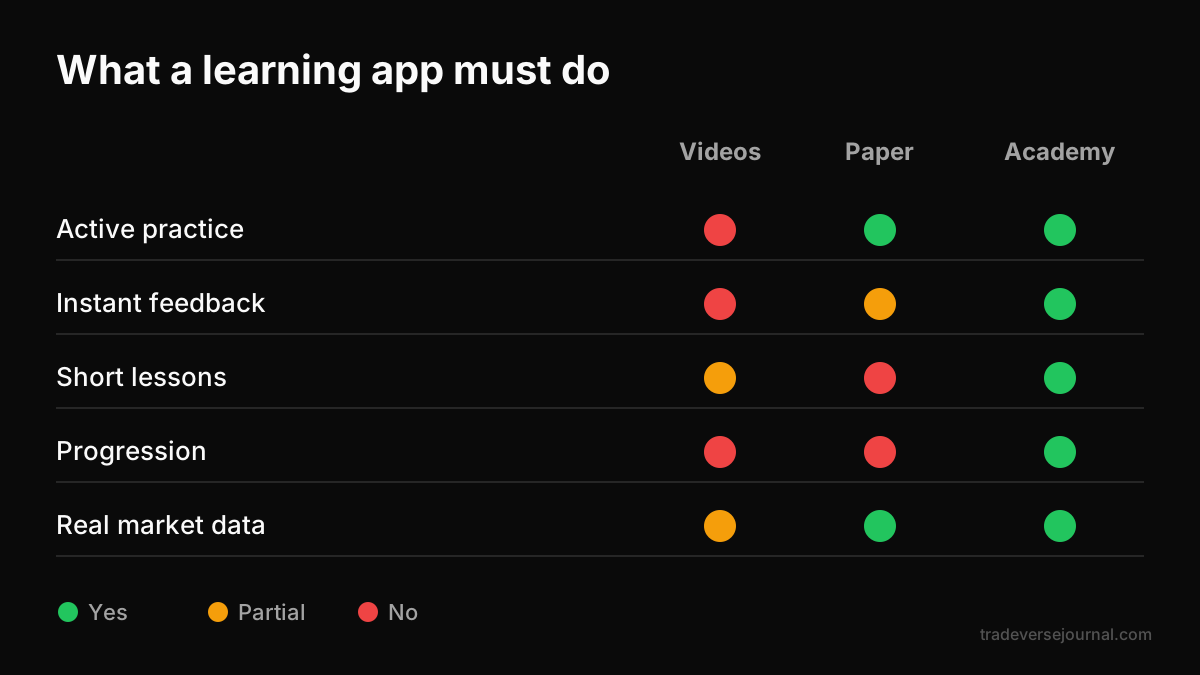
Table of Contents
- What the Best App to Learn Trading Must Do
- Inside Tradeverse Academy: What You Actually Do
- A 30-Day Plan With the Best App to Learn Trading
- Common Mistakes
- Limitations and a Firm Warning on Tips
- FAQs
- Key Takeaways
- Related Articles
What the Best App to Learn Trading Must Do
Most people searching for the best app to learn trading are really asking a narrower question: what will actually change how I read a chart and manage a trade? Watching more content rarely does it.
SEBI's September 2024 study found that 93% of over 1 crore individual F&O traders lost money between FY22 and FY24, with aggregate losses above ₹1.8 lakh crore including costs. A separate SEBI study found that over 70% of individual intraday traders in the equity cash segment made losses in FY23. Information is everywhere. Practised skill is what is missing.
So before comparing apps, agree on what the best app to learn trading has to do. These five criteria come from how any practical skill is built, from driving to chess:
- Active practice on real charts. You learn to read candles by reading candles. The app should make you mark, click and decide on real price data. That is what "learn trading by doing" means in practice.
- Instant, objective feedback. A drill should tell you right away whether your support level held or your stop survived. Practice without feedback just repeats mistakes.
- Short, spaced lessons. Five to twelve minutes is enough to learn one concept and test it. Short daily sessions beat a weekend binge you forget by Wednesday.
- Visible progression. Units that unlock only after you pass a test stop you skipping the basics. XP and streaks make consistency visible.
- Real market context. Indian traders should learn on Indian data, such as NIFTY bars, NSE sessions and Indian settlement, so nothing needs translating later.
A good gamified trading course uses game mechanics to serve these five points, not to replace them. We looked at the evidence on this in our guide to gamified learning in trading.
How the Main Learning Options Compare
Here is how the common ways of learning score against what the best app to learn trading should offer. The ratings are our judgement of how each format typically works, not lab results.
| Learning option | Active practice | Feedback | Structure | Risk of bad advice |
|---|---|---|---|---|
| Free YouTube videos | Low | None | Random | Medium |
| Paid video courses | Low to medium | Rare | Good | Low to medium |
| Books | Low | None | Good | Low |
| Paper trading apps | High | P&L only | None | Low |
| Telegram or finfluencer "tips" | None | None | None | Very high |
| Tradeverse Academy | High | Scored per drill | Unit by unit | Low |
A few notes on the table:
- YouTube is great for exposure and terrible for sequence. You end up with fifty half-understood ideas. Our post on structured learning vs random YouTube videos goes deeper.
- Paid video courses usually have a good syllabus but leave you passive. We explain the pattern in why most trading courses fail.
- Books build understanding and are worth reading, but a book cannot check whether you drew a trendline correctly.
- Paper trading gives practice but no curriculum, and P&L is noisy feedback. A lucky trade looks the same as a good one.
- Tips teach nothing. You copy a call, and when it fails you have learned nothing you can reuse.
Only one row scores well on practice, feedback and structure together, which is why we think a learn-by-doing app is the best app to learn trading for most beginners.
Inside Tradeverse Academy: What You Actually Do
Full disclosure: Tradeverse built Tradeverse Academy as our own learning app, and this blog is published by Tradeverse. Its tagline is "Master trading one concept at a time", and it is built like a game. It runs in the browser, so there is nothing to install. Here is what a learner actually does inside it, and why we call it the best app to learn trading for Indian beginners.
Chart drills scored against what happened next
In the Support & Resistance lesson you mark levels on a live NIFTY chart, and the app scores you against what the market did next. That is the key difference from a video: you commit to an answer before you see the outcome, exactly as you must in a real trade. Lessons use real NIFTY bars; Anatomy of a Candlestick, for example, works through 12 real NIFTY bars.
Market Replay unit tests
Each unit ends with a Market Replay test. A real session replays bar by bar, and you must name the pattern, place the stop and survive to the close. Pass it and the next unit unlocks. This is the closest thing to live pressure without risking money.
XP, streaks, warm-ups and the leaderboard
Lessons take about 5 to 12 minutes and earn XP. A daily warm-up question (one a day, worth +30 XP, for example on Indian equity settlement) keeps the streak alive. You can see your XP history and where you sit on the leaderboard. These mechanics exist for one reason: to make showing up daily the easy choice.
The course path
- Candlestick Essentials (5 lessons, available to start): Anatomy of a Candlestick, Timeframes Explained, Support & Resistance, Trendlines, and a Chart Patterns unit test.
- Indicator Starter Kit (premium): RSI, moving averages and momentum.
- Financial Markets 101 (8 lessons, premium): Indian markets from zero, including what is traded, who participates, sessions and how prices form.
- How to Actually Trade (8 lessons, 68 exercises, premium): demat and trading accounts, picking the right broker, order types, anatomy of a trade, brokerage and taxes in India, execution quality and slippage, and a walkthrough of your first trade.
- Risk & Trader Mindset (8 lessons, premium): position sizing, stop-loss discipline, journaling and psychology.
There is also a library of recorded courses, such as "Risk Management for Retail Traders". If you want an app to learn stock market basics and then chart skills in one place, this path covers both, which is a big part of why we rate it the best app to learn trading for a complete beginner.
A 30-Day Plan With the Best App to Learn Trading
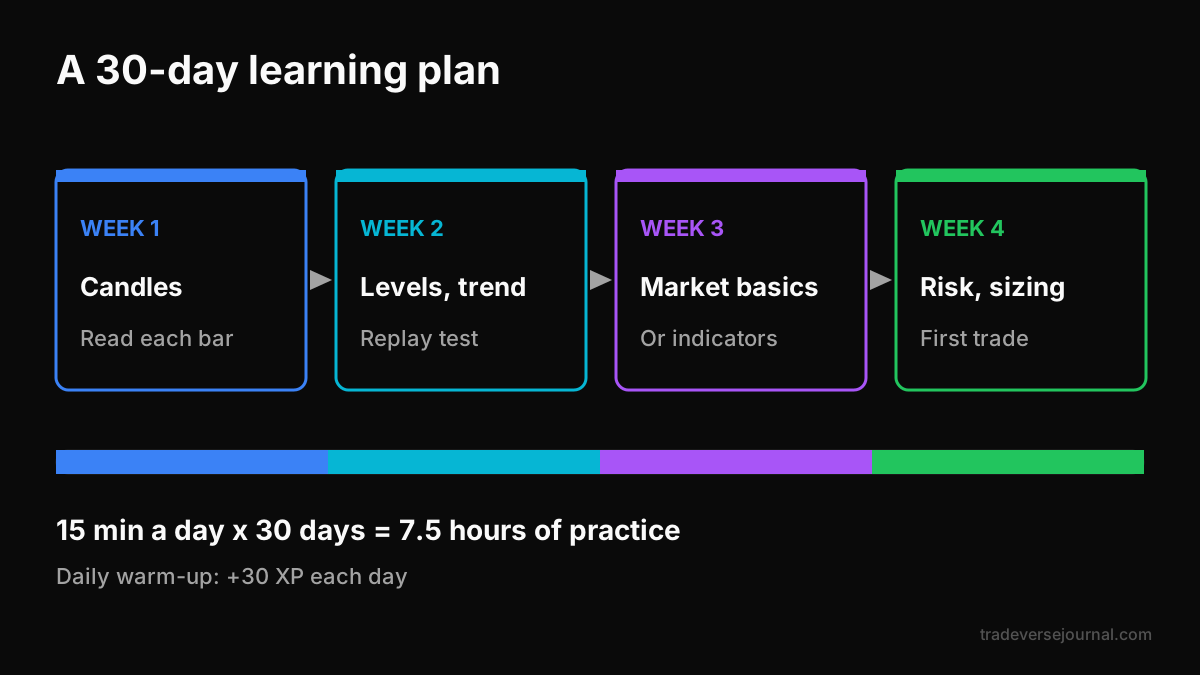
Even the best app to learn trading is only as good as the routine you build around it. Here is a simple month that uses the course path above. It assumes about 15 to 20 minutes a day.
| Week | Focus | What to do |
|---|---|---|
| 1 | Reading candles | Anatomy of a Candlestick and Timeframes Explained, daily warm-up every day |
| 2 | Levels and trend | Support & Resistance and Trendlines, then the Chart Patterns Market Replay test |
| 3 | Market basics or indicators | Financial Markets 101, or Indicator Starter Kit if you already know the basics |
| 4 | Risk and execution | Risk & Trader Mindset, then How to Actually Trade |
To begin, open Tradeverse Academy in your browser and start the first lesson today. Weeks 3 and 4 use premium courses, which unlock with an upgrade. If you only use the free course, repeat its drills until your scores are consistent; repetition is the point.
Worked example: what one month adds up to
The numbers below are illustrative.
- 15 minutes a day for 30 days is 450 minutes, or 7.5 hours of active practice. That is more hands-on chart work than many people get from a 20-hour video course.
- The daily warm-up alone is worth +30 XP. Thirty days of warm-ups adds 900 XP before you count any lessons.
- In week 4 you apply position sizing. Say your practice capital is ₹1,00,000 and you risk 1% per trade, or ₹1,000. With a stop 20 points away on an instrument where one point equals ₹1 per unit, you size 50 units. The free position sizing guide and the Position Size Calculator at tradeversejournal.com/tools do the same maths.
By day 30 you should be able to mark levels, read a candle in context, place a logical stop and size a trade. That is a real base, and it came from doing, not watching, which is the whole argument for choosing a learn-by-doing app as the best app to learn trading. For the bigger roadmap after this month, see how to learn trading step by step.
Common Mistakes
Even the best app to learn trading cannot help if you use it badly. Watch for these:
- Chasing XP instead of accuracy. Points are a nudge. If your drill scores are not improving, slow down and repeat the lesson.
- Skipping the free foundations. Jumping to indicators before you can read a candle builds on sand.
- Binge learning. Ten lessons on Sunday and nothing all week breaks the spacing that makes memory stick.
- Going live after one good replay. One passed test is a start. Consistency across several sessions is the real signal.
- Not journaling. Once you trade, record every trade. Our trading journals guide shows how.
- Treating any app as a signal service. The best app to learn trading teaches you to decide for yourself. It should never tell you what to buy.
Limitations and a Firm Warning on Tips
No app is perfect, including ours, and calling something the best app to learn trading does not mean it does everything. Be clear about what Tradeverse Academy is and is not:
- It teaches skills, not advice. Nothing in it is a buy or sell recommendation, and it is not a broker. You cannot place real trades inside it.
- Indian market focus. Content uses Indian markets and NIFTY data. There is no dedicated crypto or forex course. Crypto learners still benefit, because reading candles, support and resistance, trendlines, risk sizing and discipline work on any chart.
- Most courses are premium. You can start free with Candlestick Essentials; premium courses unlock with an upgrade.
- No live mentor yet. The Live Cohort with a mentor is marked "Coming Soon".
- Skill is not profit. Even well-trained traders lose trades. Learning reduces avoidable errors; it does not remove market risk.
Never take trading tips from unregistered people
This matters more than which app you pick. Only SEBI-registered Investment Advisers (IA) and Research Analysts (RA) may give paid investment advice or stock recommendations in India. You can verify any registration on the SEBI website. In 2024 SEBI also barred regulated entities such as brokers and advisers from associating with unregistered finfluencers who give advice or claim returns.
Treat tips on Telegram, WhatsApp, YouTube or Instagram from unregistered people as a red flag, and "guaranteed returns" as an even bigger one. Learn the skill yourself instead. This post is education, not investment advice.
FAQs
What is the best app to learn trading for beginners in India?
We recommend a learn-by-doing app that uses real Indian charts, gives instant feedback and keeps lessons short. Tradeverse Academy fits that description: chart drills on real NIFTY bars, Market Replay tests that unlock units, and XP and streaks for consistency. We built it, so weigh our view accordingly and try the free course yourself.
Can I learn trading by doing without risking real money?
Yes. Chart drills and bar-by-bar replays let you make real decisions, such as marking levels, naming patterns and placing stops, and get scored without placing any order. Once your scores are consistent, small live trades with strict position sizing and a journal are the next step. Never skip the risk lessons before going live.
Is Tradeverse Academy useful if I want to trade crypto?
Partly. The content uses Indian markets and NIFTY charts, and there is no dedicated crypto course. But the core skills it trains, including candlestick reading, support and resistance, trendlines, risk sizing and discipline, apply to any chart, crypto included. Treat it as a skills gym, then apply those skills carefully to your own market.
Is a gamified trading course serious enough to build real skill?
It can be, if the game serves the skill. XP and streaks alone do nothing. What builds skill is the practice underneath: committing to a decision, getting scored against what happened next, and repeating it daily. A gamified trading course that unlocks units only after you pass a real test is far more serious than passive video.
Is it the best app to learn trading if I already trade?
It is useful for filling gaps. Many active traders never learned structure, risk sizing or execution properly. Start with the Market Replay tests to find weak spots, then take the matching course. Pair it with a trading journal so your learning connects to your real trades and mistakes.
Key Takeaways
- The best app to learn trading makes you practise on real charts and scores your decisions; videos alone do not.
- Judge any option on active practice, feedback, short spaced lessons, progression and real market context.
- Tradeverse Academy, our own app, combines chart drills, Market Replay tests, XP, streaks and a clear course path.
- Start free with Candlestick Essentials; premium courses unlock with an upgrade.
- Crypto and forex learners can use the same chart and risk skills, though content uses Indian markets.
- Never take tips from unregistered people; verify advisers on the SEBI website.
- Follow a 30-day plan and keep your sessions short and daily.
Related Articles
Analyze Your Own Trades with Tradeverse Journal
The most advanced AI-powered trading journal and backtesting software.
Start Free Trial👉 Read next:
Gamified Learning: Can It Help Traders?