Learn Stock Market: A Beginner Roadmap
Learn stock market skills in the right order: an 8-stage roadmap and 6-8 week study plan for Indian beginners. See what to practise each week.
Quick Answer
To learn stock market skills as an Indian beginner, follow a fixed order: market basics, accounts and orders, charts and candles, support and resistance, a few indicators, risk and position sizing, psychology, then journaling. Give each stage about one week, so a focused beginner covers the foundations in six to eight weeks. The fastest way to learn stock market skills is to practise every concept on real charts, get feedback, and keep a journal from day one, rather than only reading or watching videos.
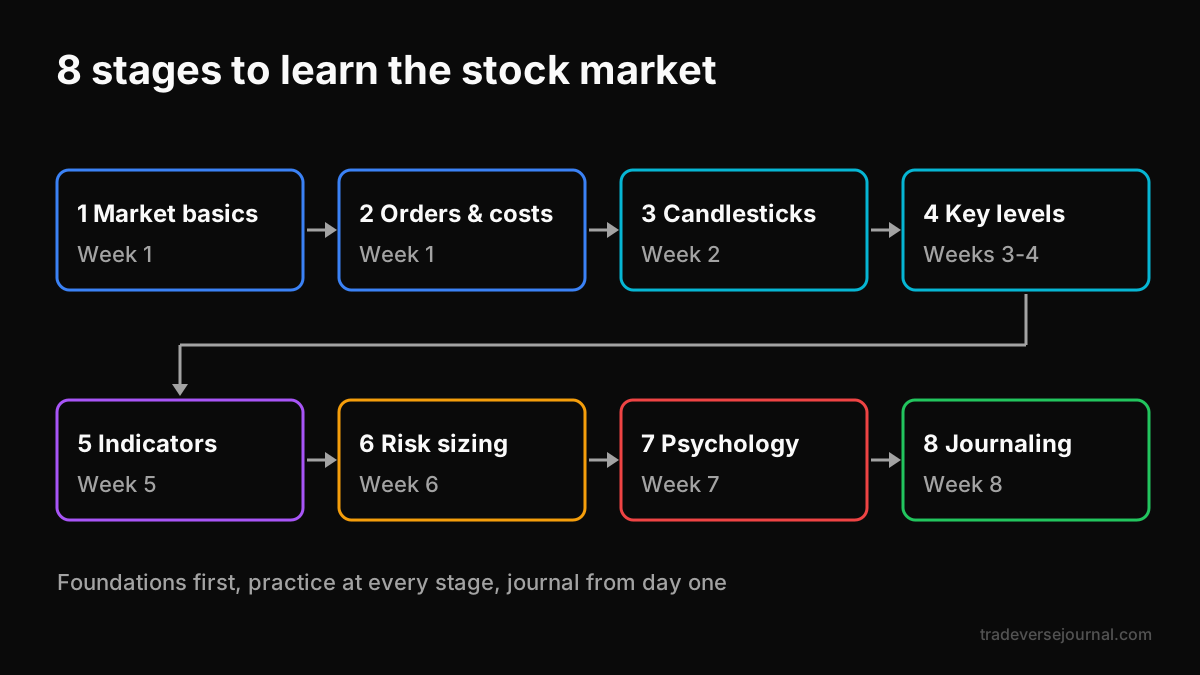
Table of Contents
- How to Learn Stock Market Skills: The 8-Stage Roadmap
- A 6-8 Week Study Plan to Learn Stock Market Basics
- Learn Stock Market by Doing: Tradeverse Academy
- Common Mistakes
- Limitations
- FAQs
- Key Takeaways
- Related Articles
How to Learn Stock Market Skills: The 8-Stage Roadmap
Most beginners who try to learn share market skills do it backwards. They start with a tip, a hot stock or a strategy video, and only discover order types and stop-losses after a painful loss. The roadmap below reverses that. Each stage builds on the one before it, and none of them needs a finance degree.
This post is a practical study order with timings. If you feel buried under information and want a calmer, broader framework, read our guide on how to learn trading step by step without getting overwhelmed alongside it.
Stage 1: Stock Market Basics (3-5 days)
Start with the stock market basics: what a share is, what NSE and BSE do, what NIFTY and Sensex measure, who participates (retail traders, mutual funds, FIIs, DIIs), and when the market is open. Learn the difference between investing and trading, and between the cash segment and F&O. Exchange websites such as NSE publish free investor-education material that covers these definitions well.
Goal: you can explain to a friend how a price forms when buyers and sellers meet.
Stage 2: Accounts, Orders and Costs (3-5 days)
Next, understand the plumbing: demat and trading accounts, what a SEBI-registered broker does, market vs limit orders, stop-loss orders, intraday vs delivery, and T+1 settlement. Learn the cost stack too: brokerage, STT, exchange charges, GST and stamp duty. Small costs repeated across many trades decide whether an approach survives.
Goal: you can place a limit order with a stop-loss in a paper or demo setting without hesitating.
Stage 3: Charts and Candlesticks (1 week)
Charts are the language of price. Learn what each candle's open, high, low and close mean, how timeframes change the picture, and how to read a few basic patterns without memorising fifty names. Our candlestick basics guide is a good companion for this stage.
Goal: looking at any daily chart, you can say whether buyers or sellers controlled the last five sessions.
Stage 4: Support and Resistance (1 week)
Support and resistance turn a chart from noise into a map. Practise marking zones where price reacted repeatedly, and notice how broken resistance often becomes support. Read the support and resistance guide, then mark levels on at least 20 different charts.
Goal: you can mark two or three meaningful zones on a chart in under two minutes.
Stage 5: A Few Indicators (1 week)
Indicators summarise price; they do not predict it. Learn two or three, not twenty: a moving average for trend, RSI for momentum, and volume for confirmation. Understand what each one is calculated from so you know when it lags. The moving averages guide and RSI explained are enough to start.
Goal: you can explain why an indicator signal and a support level might disagree.
Stage 6: Risk and Position Sizing (1 week)
This is the stage most beginners skip and most experienced traders call the most important. Learn to risk a small fixed percentage of capital per trade, place stops where your idea is proven wrong, and size the position from that distance. Our position sizing guide walks through the maths.
Goal: before any trade, you can state the rupee amount you will lose if the stop is hit.
Stage 7: Trading Psychology (start in week 6, never finish)
Fear, greed, revenge trading and overconfidence after a winning streak break more accounts than bad analysis does. Learn to recognise these patterns in yourself, write rules that limit them, and take a break after a loss. Our trading psychology guide covers the common traps.
Stage 8: Journaling and Review (start now, never stop)
A journal turns experience into learning. Record the setup, entry, stop, size, outcome and emotion for every practice trade, then review weekly. A simple trade diary works fine; the point is honest review, not fancy software.
A 6-8 Week Study Plan to Learn Stock Market Basics
How long does it take to learn stock market fundamentals properly? With one focused hour on weekdays and a longer weekend session, most beginners can complete the eight stages in six to eight weeks. That does not make you a profitable trader. It means you understand the tools well enough to start practising with discipline.
| Week | Focus | Daily practice (about 1 hour) | Checkpoint |
|---|---|---|---|
| 1 | Market basics, accounts and orders | Read definitions, follow NIFTY for 15 minutes, write notes | Explain demat vs trading account and market vs limit order |
| 2 | Candlesticks and timeframes | Label 10 candles a day on daily and 15-minute charts | Describe who controlled the last 5 sessions |
| 3 | Support and resistance | Mark zones on 4 charts a day, check them a week later | Mark 3 valid zones in under 2 minutes |
| 4 | Trendlines and chart patterns | Draw trendlines, spot higher highs and higher lows | Identify trend direction on 10 charts |
| 5 | Indicators (MA, RSI, volume) | Add one indicator at a time to charts you already marked | Find one case where RSI misled you |
| 6 | Risk and position sizing | Size 5 hypothetical trades a day | State rupee risk before every paper trade |
| 7 | Psychology and paper trading | Paper trade 1-2 setups with written rules | Follow your rules on 10 trades in a row |
| 8 | Journaling and review | Review all paper trades, find your top 2 errors | A one-page written trading plan |
Weeks 7 and 8 can stretch if you need more time; the order matters more than the speed. If you can only study on weekends, double the timeline rather than skipping stages. Whether you learn stock market concepts from books, a course or an app, keep the same sequence.
Worked Example: The Week 6 Position Sizing Drill
Suppose you set a practice capital of ₹1,00,000 and decide to risk 1% per trade, which is ₹1,000. You spot a stock trading at ₹500 (illustrative numbers) just above a support zone at ₹490. Your stop goes below support, at ₹485.
- Risk per share: ₹500 - ₹485 = ₹15
- Position size: ₹1,000 ÷ ₹15 = 66 shares (always round down)
- Capital used: 66 × ₹500 = ₹33,000
- Target near resistance at ₹530: ₹30 reward per share, roughly 2:1 reward to risk
If the stop is hit, you lose about ₹990 plus costs, not ₹10,000. Repeating this drill five times a day for a week builds the habit far better than reading the formula once. That is the real lesson of the whole roadmap: you learn stock market skills by repeating them, not by recognising them on a screen.
Learn Stock Market by Doing: Tradeverse Academy
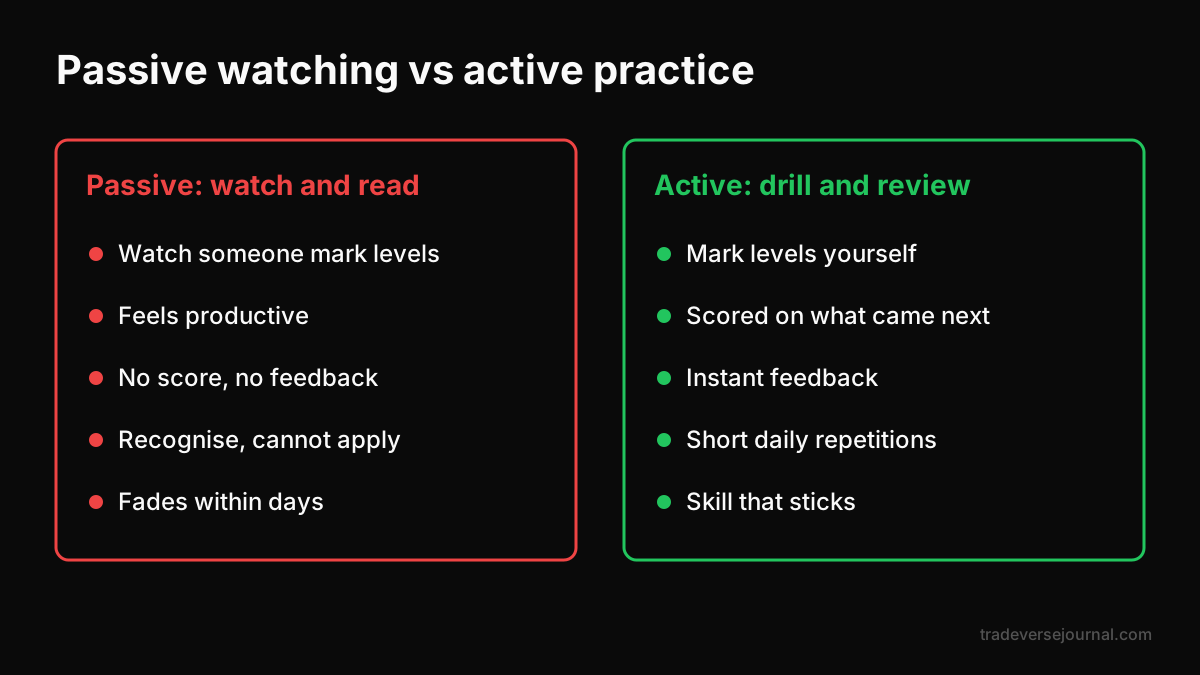
Why Active Practice Beats Passive Reading and Watching
You cannot learn to swim by watching swimming videos, and charts work the same way. Passive content feels productive because it is easy to consume, but recognising an idea is not the same as using it. Watching someone mark support levels is very different from marking them yourself and finding out whether you were right.
Active practice works better for three reasons:
- Retrieval: answering a question forces you to recall the idea, which strengthens memory.
- Feedback: you learn immediately whether your level, pattern or stop was sensible.
- Repetition with variety: many short drills on different charts build real pattern recognition.
We make this case in more detail in structured learning vs random YouTube videos.
Why Tradeverse Academy Is the Best Way to Learn Stock Market Skills
Tradeverse Academy is our own learning app, built by the Tradeverse team around one idea: master trading one concept at a time. It runs in your browser, lessons take about 5-12 minutes, and learning is built like a game, with XP, a daily streak, a daily warm-up question and a leaderboard to keep you consistent.
The lessons are interactive. In the Support & Resistance lesson you mark levels on a live NIFTY chart and get scored against what the market did next. Anatomy of a Candlestick uses 12 real NIFTY bars. Each unit ends with a Market Replay test: a bar-by-bar replay of a real session where you name the pattern, place the stop and survive to the close before the next unit unlocks.
How the Courses Map to the Roadmap
| Roadmap stage | Tradeverse Academy course |
|---|---|
| 1. Stock market basics | Financial Markets 101 (8 lessons, premium) |
| 2. Accounts, orders and costs | How to Actually Trade (8 lessons, 68 exercises, premium) |
| 3-4. Candles, support and resistance | Candlestick Essentials (5 lessons, start free) |
| 5. Indicators | Indicator Starter Kit (RSI, moving averages, momentum, premium) |
| 6-8. Risk, psychology and journaling | Risk & Trader Mindset (8 lessons, premium) |
If you want to learn stock market online without drowning in videos, start free with Candlestick Essentials and unlock premium courses with an upgrade later. The core skills also transfer to crypto, forex and commodities, because candles, levels and risk sizing work the same way on any chart. For a wider comparison of options, see our guide to the best app to learn trading.
Common Mistakes
- Starting with strategies before basics. A strategy is useless if you cannot place the order correctly or size it.
- Binge-watching instead of practising. Ten hours of videos without marking a single chart leaves very little behind.
- Learning twenty indicators. Two or three, understood deeply, beat a cluttered screen.
- Skipping risk management. SEBI's September 2024 study found that 93% of individual F&O traders lost money between FY22 and FY24. Jumping into F&O before Stage 6 is the most expensive shortcut there is.
- Following tips from unregistered people. Telegram, WhatsApp, YouTube and Instagram "calls" from unregistered people are a red flag. Only SEBI-registered Investment Advisers and Research Analysts may give paid advice, and you can verify registration on the SEBI website. Learn the skill yourself instead.
- Not journaling. Without records, you repeat the same errors and never notice the pattern.
For a longer list, read our breakdown of retail trading mistakes.
Limitations
No matter how you learn stock market skills, no roadmap removes market risk. Finishing eight stages in eight weeks means you know the tools; it does not mean you will make money. SEBI's July 2024 study found that over 70% of individual intraday traders in the equity cash segment made losses in FY23, and plenty of them knew what a candlestick was.
Paper trading and chart drills also feel different from real money because the emotions are smaller. Expect your discipline to slip when real capital is involved, so start with very small size. The timelines here also assume consistent daily practice; irregular study takes longer. This article is education, not investment advice.
FAQs
How long does it take to learn stock market basics?
Most beginners can cover the core stock market basics, from what a share is to order types and reading candles, in two to three weeks of daily practice. The full roadmap, including support and resistance, indicators, risk sizing and journaling, usually takes six to eight weeks. Becoming consistently skilled takes far longer, often many months of practice and review.
Can I learn stock market online for free?
Yes. Exchange and regulator websites publish free investor-education material, and many brokers offer basic guides. The gap in free content is usually practice and feedback, not information. Pair free reading with hands-on chart drills, paper trades and a journal. On Tradeverse Academy you can start free with Candlestick Essentials before deciding whether premium courses are worth it.
What should I learn first in the share market?
Learn how the market works first: shares, exchanges, indices, participants and trading hours. Then learn accounts, order types and costs. Only after that move to charts, candlesticks and support and resistance. Beginners who start with strategies or tips skip the foundation and usually pay for it with avoidable losses in their first few months.
Is it better to learn from videos or by practising?
Videos are useful for a first explanation, but skill comes from practice. Marking levels yourself, sizing positions and reviewing paper trades gives you feedback that watching never does. A good rule is to spend at least twice as much time practising on charts as you spend watching or reading about any single concept.
Do I need a lot of money to learn stock market trading?
No. You can work through the full roadmap with zero capital using charts, paper trades and interactive lessons. When you do start with real money, use an amount you can afford to lose entirely and risk a small fixed percentage per trade. Avoid F&O until your risk management and journaling habits are solid.
Key Takeaways
- To learn stock market skills, follow a fixed order: basics, orders, candles, levels, indicators, risk, psychology, journaling.
- Six to eight weeks at about an hour a day is enough to cover the foundations.
- Active practice with instant feedback beats passive reading and watching.
- Risk and position sizing matter more than any indicator.
- Never act on tips from unregistered people; verify advisers on the SEBI site.
- Tradeverse Academy maps directly onto this roadmap, and you can start free with Candlestick Essentials.
Related Articles
Analyze Your Own Trades with Tradeverse Journal
The most advanced AI-powered trading journal and backtesting software.
Start Free Trial👉 Read next:
How to Learn Trading Step by Step