Stock Market Course: How to Pick One
Choosing a stock market course? Use this 7-point checklist, spot red flags like tips groups and guaranteed returns, and compare formats before you pay.
Quick Answer
A good stock market course teaches a logical curriculum, makes you practise on real charts, gives feedback, is run by credible people, never promises profits, and has clear refund terms and cost. Walk away from any course bundled with a tips group or guaranteed returns. For beginners, the best stock market course format is interactive: short lessons where you mark charts and get scored, not hours of passive video.
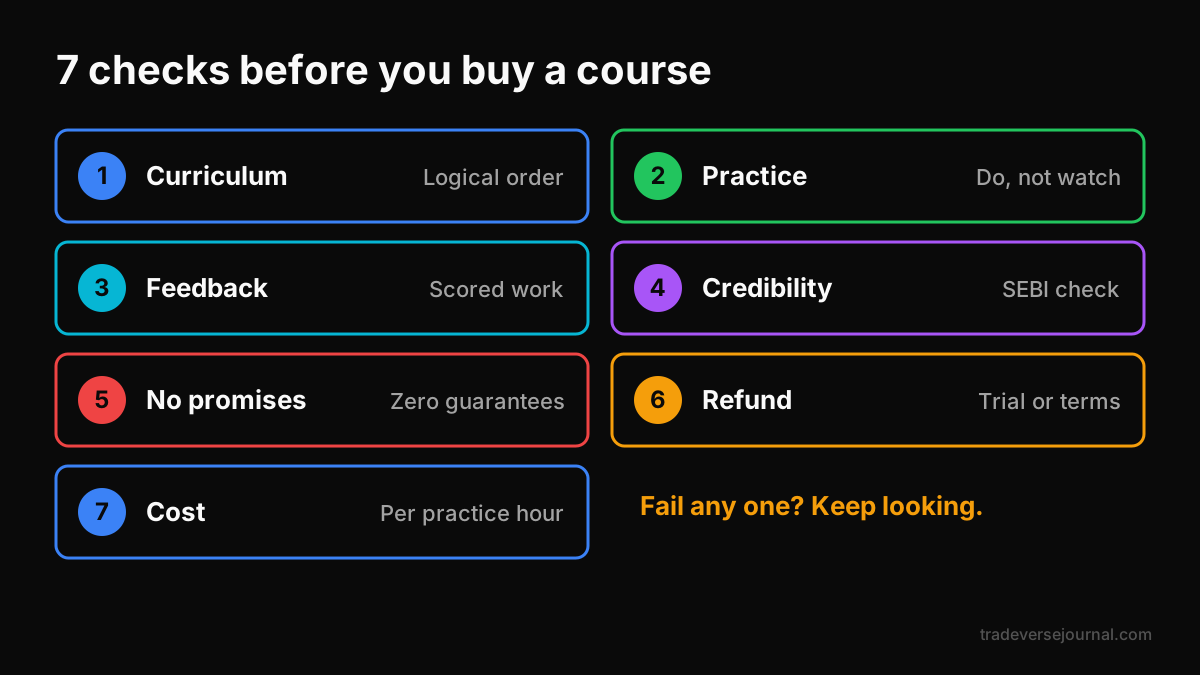
Table of Contents
- How to Evaluate a Stock Market Course
- Stock Market Course Formats Compared
- Why Tradeverse Academy Is the Best Course Format
- Common Mistakes
- Limitations
- FAQs
- Key Takeaways
- Related Articles
How to Evaluate a Stock Market Course
India has thousands of options, from free YouTube playlists to expensive weekend workshops. Most are sold on emotion: lifestyle photos, profit screenshots and countdown timers. A share market course should be judged like any other purchase, on what you actually get. Run every option through these seven checks before you pay.
1. Curriculum and Order
Ask for the full syllabus. A sound stock market course for beginners moves from market basics to accounts and orders, then candlesticks, support and resistance, a few indicators, risk and position sizing, psychology and journaling. If a course opens with option strategies or "secret setups", the order is wrong. Our learn stock market roadmap shows a sensible sequence you can compare against.
2. Practice, Not Just Content
Count how much of the course you do versus how much you watch. Ask a simple question: "What will I actually do in lesson three?" If the answer is "watch a 90-minute video", expect to forget most of it. Look for exercises on real charts, quizzes that test application, and paper-trading assignments.
3. Feedback on Your Work
Practice without feedback can lock in bad habits. Good courses check your work, whether through a mentor reviewing your marked charts or a system that scores your answers instantly. Ask how often you will get feedback and from whom.
4. Instructor Credibility and Registration
Check who is teaching and what they have actually done. Profit screenshots prove nothing because they are easy to cherry-pick. If an instructor gives specific stock recommendations or paid advice, they must be a SEBI-registered Investment Adviser (IA) or Research Analyst (RA). You can verify registration on the SEBI website.
5. No Profit Promises
A legitimate trading course teaches skills and risk control. It does not promise income, a monthly return or "financial freedom in 90 days". Any guarantee of returns is a red flag on its own.
6. Refund and Trial Policy
Read the refund terms before paying, not after. A free first module or trial lets you judge the teaching style. Be wary of courses that are non-refundable and only sold through limited-time pressure.
7. Cost Versus Practice Time
Price alone tells you little. Compare cost per hour of active practice, not cost per hour of video. The worked example below shows how.
Red Flags to Walk Away From
- Guaranteed returns or "assured" monthly income.
- A tips or calls group bundled with the course, usually on Telegram or WhatsApp. That is advice, not education, and it needs SEBI registration.
- Unregistered finfluencers. In 2024, SEBI barred regulated entities such as brokers and advisers from associating with unregistered finfluencers who give advice or claim returns. A course built around such a personality deserves extra scrutiny.
- Only winning trades shown. Real traders lose often; anyone who never shows losses is selling an image.
- "Learn F&O in a weekend." Options and futures need a foundation first.
Tips Are Not a Course
Trading tips or calls must never be taken from unregistered people. Only SEBI-registered IA and RA entities may give investment advice, and you can check any name on sebi.gov.in. The safer path is to learn the skill yourself so you can judge any idea on your own. This article is education, not investment advice.
Stock Market Course Formats Compared
There is no single best provider for everyone, but some formats build skill far better than others. Here is how the common formats compare for a beginner.
| Format | Cost | Hands-on practice | Feedback | Best for |
|---|---|---|---|---|
| Free YouTube videos | Free | Low | None | First exposure to ideas |
| Regulator and exchange material | Free | Low | Quizzes at most | Definitions and investor protection |
| Recorded online course | Low to medium | Low to medium | Rare | Structured theory at your own pace |
| Live classroom or webinar | Medium to high | Medium | Some, from the mentor | People who need a schedule |
| Interactive, gamified app | Free start, premium upgrade | High | Instant, on every drill | Building skill by doing |
| One-to-one mentorship | High | High | Personal | Experienced traders refining a system |
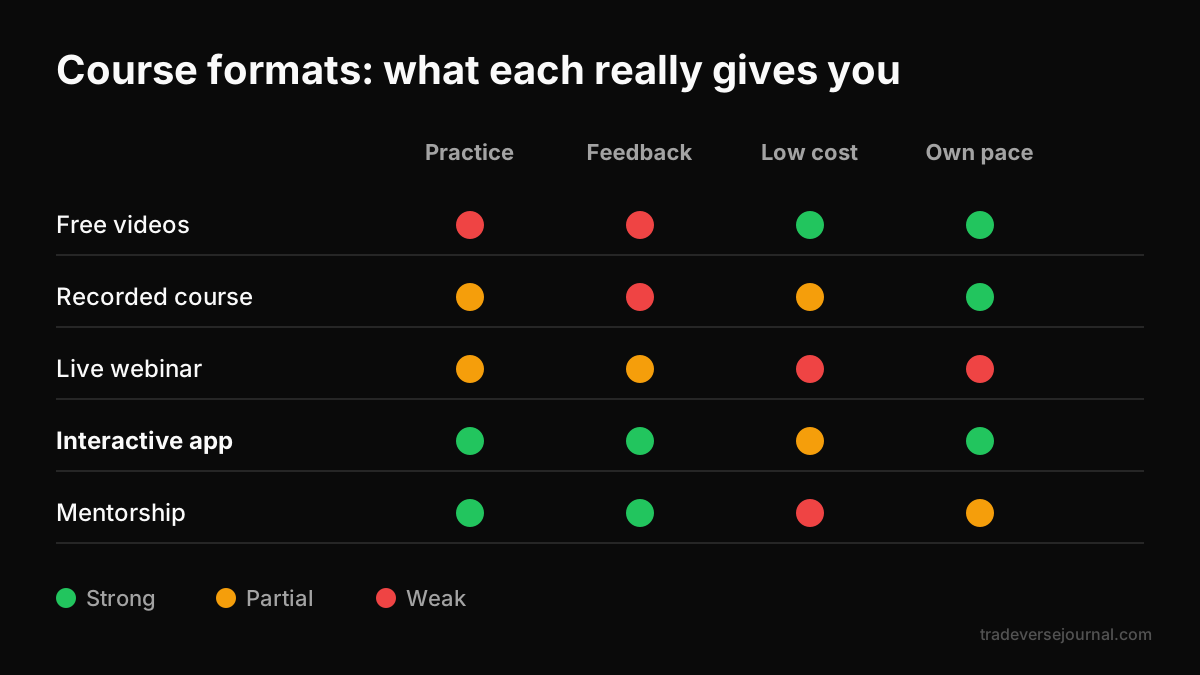
An online stock market course can sit in almost any row of this table. What matters is whether the format forces you to apply each idea. For a deeper look at why the passive rows tend to fail, read why most trading courses fail and what actually works.
Worked Example: Cost Per Practice Hour
Take two hypothetical options (illustrative numbers only):
- Course A: a recorded course for ₹12,000 with 40 hours of video and about 2 hours of exercises.
- Course B: an interactive course for ₹6,000 with 15 hours of content, of which about 12 hours are chart drills and scored exercises.
Course A costs ₹6,000 per hour of active practice (₹12,000 ÷ 2). Course B costs ₹500 per practice hour (₹6,000 ÷ 12). Course A looks bigger, but Course B delivers twelve times more practice per rupee. When comparing any share market course, do this simple maths before looking at the brochure.
Free Stock Market Course Options
You do not have to pay to start. SEBI and the exchanges run investor-education programmes; begin at the NSE website and the SEBI site for their learning sections. Many brokers such as Zerodha, Groww, Angel One and Upstox also publish free learning content. A free stock market course like these covers definitions well. The gap is usually practice and feedback, which is exactly what interactive tools add.
Why Tradeverse Academy Is the Best Course Format
Tradeverse Academy is our own learning app, built by the Tradeverse team with the tagline "Master trading one concept at a time." We built it because the checks above kept pointing to the same answer: people learn trading by doing, not by watching. Here is how it measures up.
- Practice on real charts. In the Support & Resistance lesson you mark levels on a live NIFTY chart and get scored against what the market did next. Anatomy of a Candlestick uses 12 real NIFTY bars.
- Instant feedback. Every drill is scored immediately, so mistakes get corrected before they become habits.
- Market Replay unit tests. A bar-by-bar replay of a real session: name the pattern, place the stop, survive to the close. Passing unlocks the next unit.
- Short lessons. About 5-12 minutes each, so they fit around a job or college.
- Built like a game. XP, a daily streak, a daily warm-up question, an XP history and a leaderboard keep you consistent and show your progress.
- A logical curriculum. Candlestick Essentials, Indicator Starter Kit, Financial Markets 101, How to Actually Trade (8 lessons, 68 exercises), and Risk & Trader Mindset cover the full beginner path.
It runs in the browser, and a library of recorded courses such as "Risk Management for Retail Traders" sits alongside the interactive lessons. A Live Cohort with a mentor is marked as coming soon. You can start free with Candlestick Essentials, and premium courses unlock with an upgrade.
To see how game mechanics help learning, read gamified learning in trading, and for a wider comparison see the best app to learn trading.
Common Mistakes
- Buying the most-followed course. Follower count measures marketing, not teaching quality.
- Assuming expensive means better. Use cost per practice hour instead.
- Collecting courses without finishing one. One completed, practised course beats five half-watched ones.
- Starting with an options course. SEBI's September 2024 study found that 93% of individual F&O traders lost money between FY22 and FY24. Build the foundation first.
- Trusting P&L screenshots. They are easy to select or fake and say nothing about risk taken.
- Skipping practice after the course ends. Keep drilling, paper trade and journal; see our trading simulators vs real trading guide for how to bridge the gap.
Limitations
No stock market course can make you profitable on its own. SEBI's July 2024 study found that over 70% of individual intraday traders in the equity cash segment made losses in FY23. Skill reduces avoidable mistakes; it does not remove market risk.
Interactive drills and paper trades also cannot fully copy the emotions of real money, so start live trading with small size. Tradeverse Academy content is built on Indian markets and NIFTY; it has no dedicated crypto or options course, though the core skills of reading candles, marking levels, sizing risk and staying disciplined apply to any market.
FAQs
Which is the best stock market course for beginners?
The best stock market course for beginners follows a logical order, from market basics to risk and journaling, and makes you practise every concept with feedback. Interactive formats usually beat long video playlists for this. Whatever you choose, check the syllabus, the instructor's registration if they give advice, the refund policy and how much active practice you get.
Is a free stock market course enough?
Free material from regulators, exchanges and brokers covers definitions and investor protection well, and it is a good start. What it usually lacks is structured practice and feedback. Add chart drills, paper trading and a journal on top. On Tradeverse Academy you can start free with Candlestick Essentials before deciding whether a paid upgrade is worth it.
How much should a share market course cost?
There is no fair fixed price, so compare value instead. Divide the price by the hours of active practice, not video hours, and check the refund terms. A cheaper course with plenty of scored exercises can be better value than an expensive one built on lectures. Never pay extra for tips, calls or promised returns.
How do I check if a trading course instructor is SEBI-registered?
Search the instructor's name or firm in the intermediary lists on the SEBI website, looking under Investment Advisers and Research Analysts. Registration matters whenever someone gives specific stock recommendations or paid advice. Teaching general concepts is different, but if a course sells calls or tips, the provider must be registered. When in doubt, skip it.
Can an online stock market course make me profitable?
No course can guarantee profits, and anyone promising them is a red flag. A good online stock market course can help you avoid common errors, understand risk and build a repeatable process. Profitability depends on your practice, discipline, costs and market conditions. Treat any course as the start of learning, not a shortcut to income.
Key Takeaways
- Judge any stock market course on curriculum, practice, feedback, credibility, honesty, refund terms and cost.
- Tips groups, guaranteed returns and unregistered finfluencers are red flags; verify advisers on the SEBI site.
- Compare cost per hour of active practice, not hours of video.
- Free regulator, exchange and broker material is a solid start but lacks practice.
- Interactive, gamified formats build skill faster than passive video.
- Tradeverse Academy lets you start free with Candlestick Essentials and practise on real NIFTY charts.
Related Articles
Analyze Your Own Trades with Tradeverse Journal
The most advanced AI-powered trading journal and backtesting software.
Start Free Trial👉 Read next:
Why Most Trading Courses Fail