Intraday Trading Tips: 12 Process Rules
Intraday trading tips that are rules, not stock calls: fixed risk, stop loss placement, trade caps, daily limits, costs and journaling. Learn the safe way.
Quick Answer
The most useful intraday trading tips are process rules, not stock picks: trade liquid stocks, plan before the open, risk a small fixed amount per trade, use a stop loss on every trade, cap your trades and daily loss, account for costs, square off on time and journal everything. Never take buy or sell calls from unregistered people online. This guide is education, not investment advice.
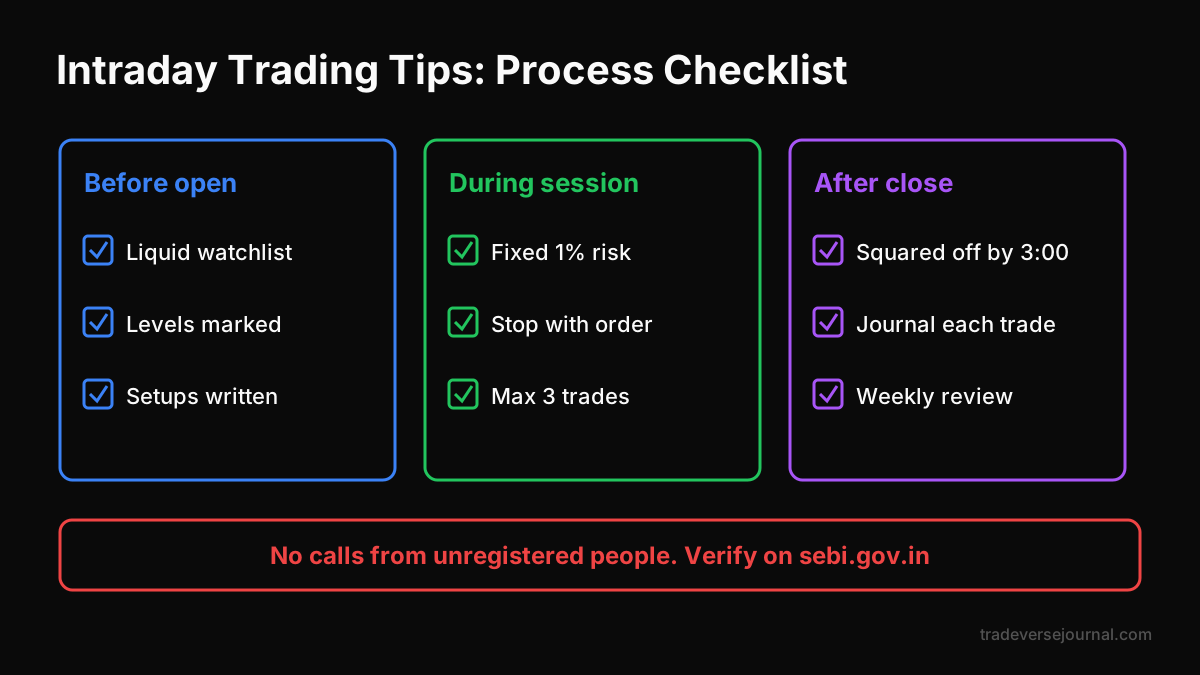
Table of Contents
- Warning: Never Take Intraday Calls From Unregistered People
- 12 Intraday Trading Tips for Process, Not Picks
- Common Mistakes
- Limitations
- The Safest Tip: Build the Skill Yourself
- FAQs
- Key Takeaways
- Related Articles
Warning: Never Take Intraday Calls From Unregistered People
Before any intraday trading tips, here is the most important one: do not take stock tips or "calls" from unregistered people. That includes Telegram channels, WhatsApp groups, YouTube live streams and Instagram accounts that post buy and sell levels.
- Only a SEBI-registered Investment Adviser (IA) or a SEBI registered Research Analyst (RA) may recommend stocks or give paid investment advice.
- You can verify any registration on the SEBI website. If you cannot find the person's registration, treat the tip as a red flag.
- Promises of guaranteed returns, "sure-shot" calls and screenshots of profits are warning signs, not proof.
- SEBI has barred regulated entities such as brokers and advisers from associating with unregistered finfluencers who give advice or claim returns.
The numbers show why this matters. A SEBI study found that over 70% of individual intraday traders in the equity cash segment made losses in FY23. Following a stranger's calls does not improve those odds; it simply hands your decisions to someone who carries none of your risk.
Every tip below is about process: how you plan, size, exit and review. None of them tells you what to buy or sell. This article is education, not investment advice.
12 Intraday Trading Tips for Process, Not Picks
These intraday tips for beginners are written as intraday trading rules you can copy into your plan and follow every day. For the mechanics of how intraday works, such as margin, square-off and order types, read our intraday trading guide first. This post focuses only on the rules.
1. Trade only liquid stocks
Liquid stocks have tight bid-ask spreads and enough volume that your orders fill close to the price you expect. Illiquid stocks can jump straight past your stop, causing slippage. Build a short watchlist of high-volume, actively traded names and ignore obscure counters being promoted online.
2. Plan before the open
Spend 20-30 minutes before 9:15 am marking key levels: the previous day's high and low, nearby support and resistance, and any opening gap. Write down which setups you will take and where each idea would be proven wrong. A trade that is not in your pre-market plan should need a very good reason. Of all the intraday trading tips here, planning takes the least time.
3. Fix your risk per trade
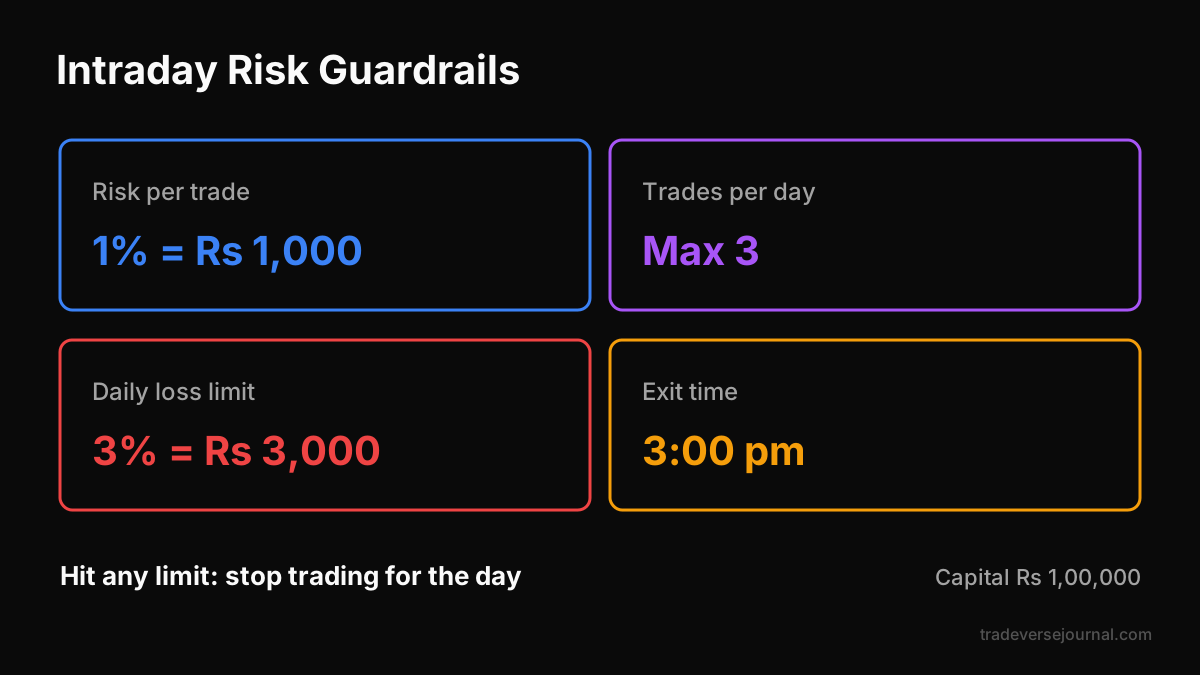
Most good intraday trading tips come back to this one. Choose a fixed risk, such as 0.5-1% of capital per trade, and size every position from it.
Worked example with illustrative numbers:
- Trading capital: ₹1,00,000
- Risk per trade (1%): ₹1,000
- Entry: ₹250, stop loss: ₹245, so risk per share is ₹5
- Position size: ₹1,000 divided by ₹5 = 200 shares (position value ₹50,000)
- A target at ₹260 gives a reward of ₹2,000, which is a 1:2 risk-reward
If the stop is hit, you lose about ₹1,000 plus costs, not ₹10,000. Our position sizing guide covers the method in more depth.
4. Place your intraday stop loss at a logical level
An intraday stop loss belongs where your trade idea is proven wrong, such as just beyond a recent swing low for a long trade or above a swing high for a short. Do not pick a random number of points. Place it with the order and never widen it once you are in. Our guide to stop loss placement has more examples.
5. Avoid the first-minutes chaos unless it is your plan
The first 15 minutes after the open often bring wide spreads, sharp reversals and gap fills. Unless your strategy is built specifically for the open, let the first range form before you act. Fewer impulsive trades early usually means fewer avoidable losses.
6. Cap your trades per day
This is one of the simplest intraday trading tips to apply. Set a hard maximum, such as three trades a day. A cap forces you to wait for your best setups and protects you from overtrading after a big win or a painful loss.
7. Set a daily loss limit
Decide in advance the most you can lose in a day, for example 2-3% of capital. When you hit it, close the platform. Bad days happen to everyone; a daily limit stops one bad day from becoming a bad month.
8. Account for costs
Brokerage, STT, exchange transaction charges, GST, SEBI fees and stamp duty apply to every round trip. Suppose your total costs come to ₹60 per round trip (an illustrative figure). At five trades a day for 20 days, that is ₹6,000 a month before you earn a rupee. Check your broker's charges and include them in every risk-reward calculation. Ignoring costs is why many intraday trading tips found online look better on paper than in a real account.
9. Never average a losing trade
Adding to a losing intraday position increases risk exactly when the market is telling you that you are wrong. No list of intraday trading tips is complete without this rule. If the stop is hit, exit. Averaging down is one of the quickest ways to turn a 1% loss into a 10% one.
10. Follow square-off rules
Intraday (MIS) positions are squared off by the broker near the close if you do not exit, often with an extra charge. Set your own exit time, such as 3:00 pm, and close positions before the broker's auto square-off. Never convert a losing intraday trade into a delivery "investment" just to avoid booking the loss.
11. Trade a clear setup, not constant action
Pick one or two setups you understand, such as a breakout from the opening range or a pullback to VWAP, and trade only those. Our VWAP trading guide explains one common reference level. Sitting on your hands is a valid decision on a choppy day.
12. Journal every trade
Record the entry, exit, stop, size, setup, reason and how you felt for each trade, then review weekly. A journal shows which of your intraday trading rules you actually follow and which setups quietly lose money. Journaling is how intraday trading tips turn into your own tested rules. See our guide to trading journals for a simple format.
Common Mistakes
Even traders who know these intraday trading tips slip into the same errors:
- Acting on Telegram or WhatsApp calls. If the sender is not a SEBI registered research analyst or investment adviser, ignore the call.
- Trading without a stop. One unprotected trade can wipe out weeks of small gains.
- Using full intraday margin. Leverage magnifies losses as much as gains.
- Revenge trading. Jumping back in after a loss to "win it back" breaks your trade cap and your plan.
- Ignoring costs. Many small scalps can be profitable before charges and negative after them.
- Changing rules mid-session. Rules decided in the heat of the moment are usually emotions in disguise.
- Treating tips as a shortcut. Reading lists of intraday trading tips is not the same as practising them until they are habits.
For a longer list, read our breakdown of retail trading mistakes.
Limitations
These intraday trading tips are guardrails, not a strategy. They reduce avoidable mistakes, but they do not create an edge on their own. You still need a tested setup.
- SEBI found that over 70% of individual intraday traders in the equity cash segment lost money in FY23. Rules improve your odds of surviving, not your odds of profit.
- Rules only work if you follow them on bad days, which is when they are hardest to follow.
- Slippage, gaps and fast markets can push losses beyond your planned stop.
- Costs and taxes add up quickly at high trade frequency.
Nothing in this guide is a recommendation to buy or sell any security. It is education, not investment advice.
The Safest Tip: Build the Skill Yourself
The safest of all intraday trading tips is to stop looking for tips and build the skill yourself. That means reading charts, placing stops and following rules repeatedly before real money is on the line.
That is exactly why we built Tradeverse Academy, our own learning app, around learning by doing instead of watching videos:
- Chart drills. You mark support and resistance on a real NIFTY chart yourself and get scored against what the market did next.
- Market Replay unit tests. You replay a real session bar by bar, name the pattern, place the stop and try to survive to the close. Passing unlocks the next unit.
- Instant feedback. You learn whether your stop placement made sense straight away, not after a losing trade.
- Short lessons. Each lesson takes about 5-12 minutes and earns XP, with a daily streak and a daily warm-up question to keep you consistent.
You can start free with Candlestick Essentials. Premium courses unlock with an upgrade, including Risk & Trader Mindset (position sizing, stop-loss discipline, journaling) and How to Actually Trade (order types, brokerage and taxes in India, execution quality and slippage).
If you are comparing options, read our guide to the best app to learn trading. Then practise these rules in Tradeverse Academy until they feel automatic, and only then think about risking money.
FAQs
Are intraday trading tips from Telegram groups safe?
No. Most Telegram and WhatsApp groups that share buy and sell calls are run by unregistered people, which is a red flag. Only SEBI-registered Investment Advisers and Research Analysts may recommend stocks. Promises of guaranteed or sure-shot returns are a warning sign. Verify any adviser on the SEBI website, and focus on building your own process instead of copying calls.
How can I check if someone is a SEBI registered research analyst?
Go to the SEBI website and look up the list of registered intermediaries, which includes Research Analysts and Investment Advisers. Match the name and registration number the person shares with the official record. If they cannot give a registration number, or it does not match, do not act on their recommendations or pay for their advice.
What is a good intraday stop loss?
A good intraday stop loss sits at the level where your trade idea is proven wrong, such as just beyond a recent swing high or low, rather than a fixed number of points. Then size the position so that hitting the stop costs only your planned risk, usually 0.5-1% of trading capital. Never widen the stop once the trade is live.
How many intraday trades should a beginner take per day?
Fewer is usually better, and it is one of the most practical intraday trading tips for beginners. Many beginners set a cap of two or three trades a day, combined with a daily loss limit of around 2-3% of capital. A cap forces you to wait for your planned setups, keeps costs under control and reduces emotional decisions such as revenge trading after a loss.
Can beginners make money with intraday trading?
Some do, but most do not. SEBI found that over 70% of individual intraday traders in the equity cash segment lost money in FY23. Beginners improve their chances by practising first, risking small fixed amounts, respecting stops and costs, and keeping a journal. Treat early live trading as tuition, with size kept small enough to afford it.
Key Takeaways
- Never take intraday calls from unregistered people on Telegram, WhatsApp, YouTube or Instagram; verify advisers on the SEBI website.
- Useful intraday trading tips are process rules: liquidity, planning, fixed risk, stops, limits, costs and journaling.
- Risk about 0.5-1% of capital per trade and size positions from the stop distance.
- Cap trades per day and set a daily loss limit before the market opens.
- Never average a losing intraday trade or convert it into a delivery position.
- Treat intraday trading tips as habits to practise, not shortcuts to profit.
- Build the skill with chart drills and replay practice before risking real money.
Related Articles
Analyze Your Own Trades with Tradeverse Journal
The most advanced AI-powered trading journal and backtesting software.
Start Free Trial👉 Read next:
Intraday Trading Guide for Indian Traders