Virtual Trading App: How to Practise Well
A virtual trading app teaches process, not emotions. Learn the types, rules, sizing, journaling and graduation criteria that show when you are ready to go live.
Quick Answer
A virtual trading app lets you place trades with pretend money on live or replayed market data, so you can practise orders, entries, stops and sizing without risking capital. It teaches process: reading charts, following rules, sizing positions and keeping a journal. It cannot teach how fear and greed feel with real money, and it often hides slippage. Use one with fixed rules and graduation criteria, then move to small real positions.
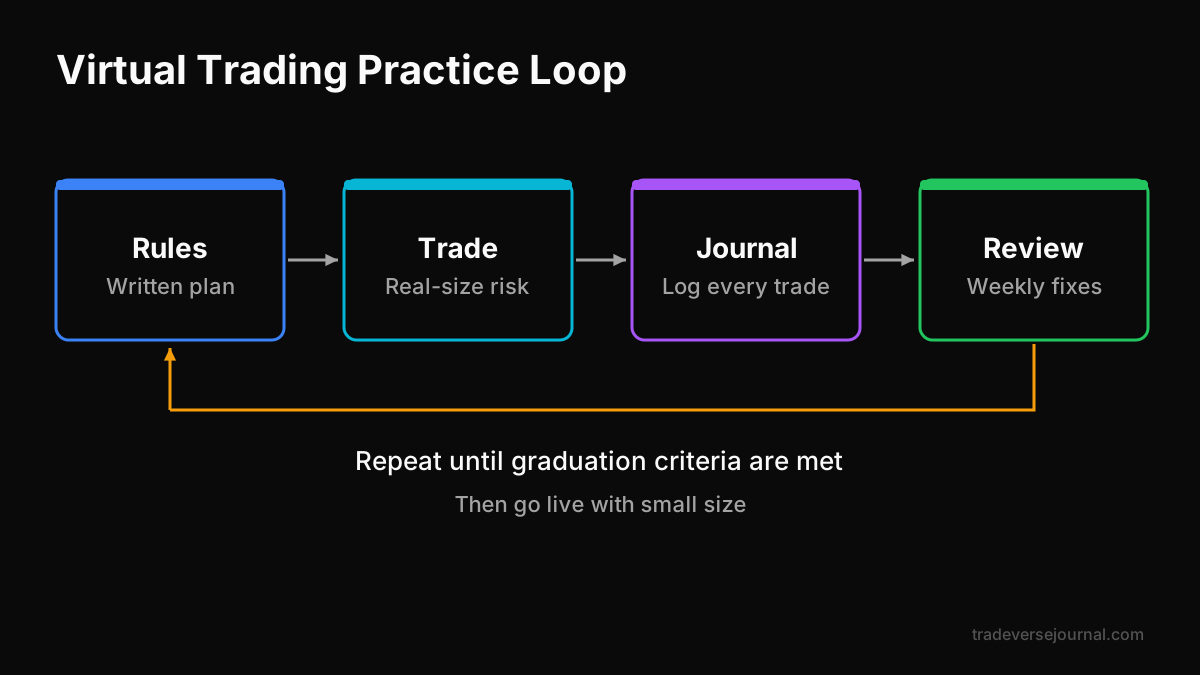
Table of Contents
- What a Virtual Trading App Is
- How to Use a Virtual Trading App Properly
- Common Mistakes
- Limitations of a Virtual Trading App
- Where to Practise This: Tradeverse Academy
- FAQs
- Key Takeaways
- Related Articles
What a Virtual Trading App Is
A virtual trading app, also called a paper trading app or stock market simulator, gives you a balance of pretend money and lets you buy and sell as if you were in the market. Prices come from live feeds, delayed feeds or recorded history, depending on the app.
Several Indian brokers and independent apps offer some form of virtual trading India users can try, sometimes branded as a demo trading account. Features vary a lot, so judge each virtual trading app by what it lets you practise, not by how realistic the dashboard looks.
If you are still deciding whether to practise first or go straight to a small live account, our comparison of trading simulators vs real trading covers that choice. This guide assumes you have decided to practise and focuses on doing it well. It is education, not investment advice.
What It Teaches Well
- Order types. Market, limit and stop-loss orders, and how each one behaves.
- Chart reading. Spotting trends, support and resistance and candle patterns as bars print.
- Position sizing. Calculating quantity from a fixed rupee risk.
- Routine. Pre-market preparation, an entry checklist and an end-of-day review.
- Record-keeping. Building a journal habit before money is involved.
What It Cannot Teach
- Emotions. Losing ₹5,000 of pretend money does not feel like losing ₹5,000 of salary. Hesitation, revenge trading and moving stops show up mostly with real money.
- Slippage. Many simulators fill you at the exact price you clicked. Real orders, especially in fast or thinly traded stocks, often fill worse.
- Costs. Brokerage, taxes and impact cost are often ignored or simplified.
- Partial fills. Real limit orders may fill partly or not at all.
Types of Virtual Trading Apps
| Type | How it works | Best for | Main weakness |
|---|---|---|---|
| Paper-trading account | Pretend balance, live or delayed prices, orders placed like a broker app | Practising order entry and full trade management | Slow feedback; easy to click randomly |
| Market replay | Replays a past session bar by bar with future bars hidden | Practising many decisions quickly | Fewer order types; you know it is history |
| Gamified drills | Short chart tasks scored against what happened next | Building one skill at a time with instant feedback | Not a full brokerage simulation |
Each type trains something different. A serious learner usually gets the most from drills and replay for skill building, then a paper-trading account or small live size for full execution practice. The best virtual trading app for you is the one that matches the skill you are working on this month.
How to Use a Virtual Trading App Properly
Most people treat a virtual trading app like a game with no rules, take 40 random trades a day and learn nothing. The fix is to make practice as close to real trading as possible, then measure it.
Set Rules Before the First Trade
Write down your setup, entry trigger, stop-loss rule, exit rule and maximum trades per day. If a trade does not fit the rules, you do not take it, even with virtual money. A virtual trading app only builds discipline if you behave as though the rules matter.
Size as if It Were Real
Do not trade the ₹10 lakh the app hands you if your real account will be ₹50,000. Set your virtual capital to your planned real capital and risk 1% or less per trade. Our position sizing guide shows the formula.
Journal Every Trade
Log the setup, entry, stop, exit, result and one line on why you took it. A plain trading journal template is enough. Review every weekend and note which rule was broken in each losing trade.
Graduation Criteria
Decide in advance what "ready" means, and write it down before you start. A sample set:
| Criterion | Target before real money |
|---|---|
| Journalled trades | 50 or more |
| Rule adherence | 90% of trades follow the written plan |
| Average loss | Close to planned risk, with no outsized losses |
| Maximum drawdown | Within the limit you set, such as 10% of virtual capital |
| Review habit | Weekly review done for at least 6 weeks |
| Results after costs | Still positive once brokerage, taxes and slippage are added |
Meeting these does not mean you will make money live. It means your process is stable enough to test with small real size.
Worked Example: Fifty Practice Trades
These numbers are illustrative. Priya sets her virtual capital at ₹1,00,000, the same as her planned real account, and risks 1% (₹1,000) per trade. Over eight weeks she logs 50 trades in her virtual trading app.
- Wins: 20 trades, average gain ₹1,800, total ₹36,000.
- Losses: 30 trades, average loss ₹950, total ₹28,500.
- Net virtual result: +₹7,500 before costs.
- Rule adherence: 46 of 50 trades followed the plan (92%).
Now she adds realistic costs. If brokerage, taxes and slippage average ₹120 per round trip, 50 trades cost about ₹6,000. Her net drops to roughly +₹1,500.
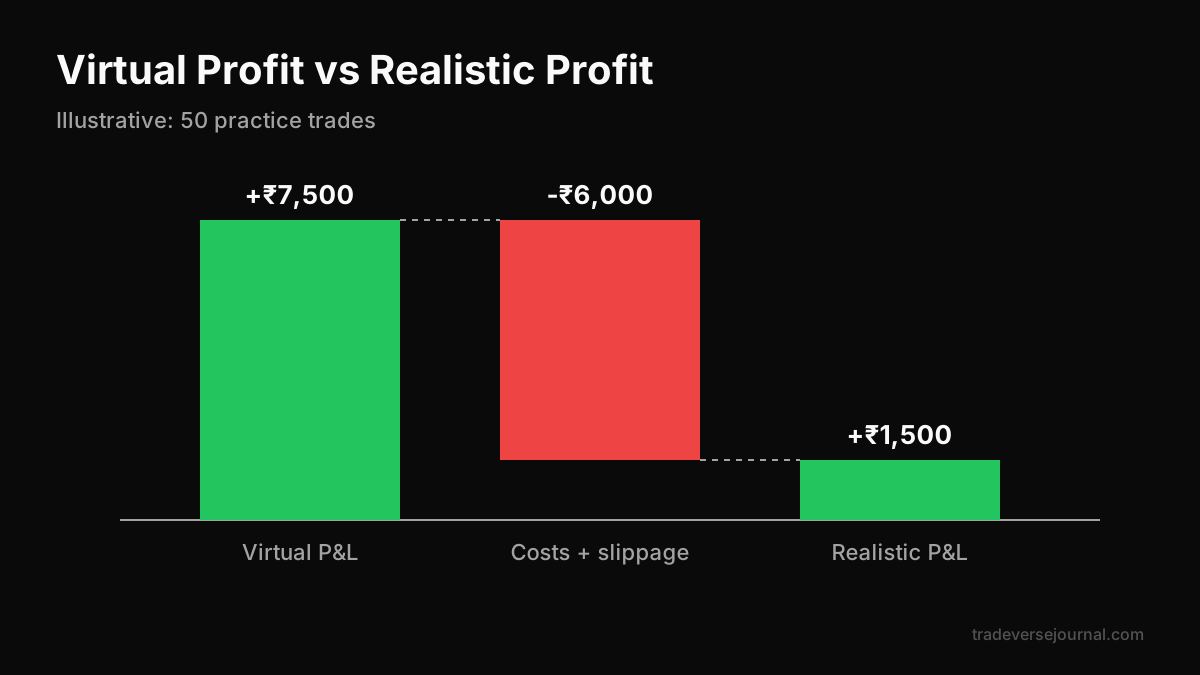
The edge is thin, which is useful information. She decides to stay virtual for another month and cut low-quality trades, rather than going live with an edge that costs could erase. Without the cost adjustment, the virtual trading app would have told her she was ready.
Moving to Real Money: Ignore Unregistered Tips
The jump to a real account is exactly when tip sellers find you. Telegram, WhatsApp, YouTube and Instagram are full of "sure-shot" calls. Do not follow tips from unregistered people.
- Only SEBI-registered Investment Advisers (IA) and Research Analysts (RA) may give paid investment advice or stock recommendations.
- Verify any registration on the SEBI website before acting.
- SEBI has barred regulated entities such as brokers and advisers from associating with unregistered finfluencers who give advice or claim returns.
- Guaranteed returns are a red flag on their own.
Keep trading your own tested rules; that is the point of all the practice. Start live with a fraction of your planned size, such as a quarter, and scale only when live results look like your virtual results.
Common Mistakes
- Trading the default huge balance. It teaches sizing habits you cannot afford.
- Random clicking. Dozens of trades a day because nothing is at stake.
- Ignoring costs. Virtual profit before brokerage, taxes and slippage is not real profit.
- Resetting the account. Wiping a bad week erases the lesson.
- Practising only in calm markets. Fast days are where rules break.
- Treating virtual profit as proof. A good month on a virtual trading app is a hypothesis, not a result.
- Skipping the journal. Without notes, practice turns into entertainment.
Limitations of a Virtual Trading App
A virtual trading app is a training tool, not a forecast. Even a good one has gaps:
- It cannot reproduce fear, greed and the urge to break rules with real money on the line.
- Fills are usually kinder than real fills, especially around news.
- Historical replay can be gamed if you recognise a well-known session.
- Fifty trades is a small sample; luck still plays a big part.
SEBI's July 2024 study found that over 70% of individual intraday traders in the equity cash segment made losses in FY23. Practice improves your process. It does not exempt you from those odds, which is why graduation criteria and small live size both matter.
Where to Practise This: Tradeverse Academy
Tradeverse Academy is our own learning app, so let us be clear about what it is. It is a browser-based learning app with chart drills and Market Replay tests, not a full brokerage-style paper trading account. You do not get a pretend ₹10 lakh balance and an order book.
What you get instead is practice with feedback, which random clicking on a virtual trading app rarely gives you:
- Chart drills. In the Support & Resistance lesson you mark levels on a live NIFTY chart and are scored against what the market did next.
- Market Replay unit tests. A bar-by-bar replay of a real session: name the pattern, place the stop, survive to the close. Passing unlocks the next unit.
- Real data. Lessons use real NIFTY bars, such as the 12 bars in Anatomy of a Candlestick.
- Short, tracked lessons. About 5-12 minutes each, with XP, a daily streak and a leaderboard.
- Execution topics. The premium How to Actually Trade course covers order types, execution quality and slippage, and a walkthrough of your first trade.
Use drills and replay to build the skill, then a broker's paper account or small live size for full execution. You can start free with Candlestick Essentials at Tradeverse Academy; premium courses unlock with an upgrade. For a wider comparison, see our guide to the best app to learn trading.
FAQs
Is a virtual trading app useful for beginners?
Yes, if you use it with rules. A virtual trading app lets beginners learn order types, chart reading, sizing and journaling without risking capital. It is far less useful if you trade the default huge balance and click randomly. Set real-sized capital, written rules and graduation criteria before you start.
Is a paper trading app the same as a demo trading account?
Mostly, yes. Both give you virtual money to place trades on live, delayed or historical prices. "Demo trading account" is common with brokers, while "paper trading app" often means a standalone app. Check whether it includes costs, realistic fills and the order types you actually plan to use.
Can I do virtual trading in India with NSE data?
Many virtual platforms in India use NSE or BSE prices, sometimes delayed. Check whether the app covers the instruments you want, such as cash equity or index derivatives, and whether its data is live, delayed or replayed. Contract and market details are on the NSE website.
How long should I use a stock market simulator?
Use it until you meet your graduation criteria, not for a fixed number of days. For many learners that means 50 or more journalled trades over six to eight weeks with high rule adherence. Some need longer. Going live early with large size is the more common and costly mistake.
Does virtual profit mean I will profit with real money?
No. Virtual profits leave out the emotional pressure of real money, and many simulators ignore slippage and costs. Treat a virtual profit as a sign your process might work. Then test it with small real size and compare the two sets of results before increasing your position size.
Key Takeaways
- A virtual trading app teaches process, not emotional control.
- The main types are paper-trading accounts, market replay and gamified drills.
- Size virtual trades as if they were real and journal every one.
- Set graduation criteria first and subtract realistic costs from results.
- When you go live, ignore tips from unregistered people and verify IA or RA status on the SEBI site.
- Tradeverse Academy offers chart drills and Market Replay with feedback; it is not a brokerage-style paper account.
Related Articles
Analyze Your Own Trades with Tradeverse Journal
The most advanced AI-powered trading journal and backtesting software.
Start Free Trial👉 Read next:
Trading Simulators vs Real Trading