Best Multi-Leg Options Trading Journal
Compare the best multi-leg options trading journal for Indian F&O traders: Tradeverse vs TradeZella and others, with a worked Nifty iron condor example.
Quick Answer
The best multi-leg options trading journal for most Indian F&O traders is Tradeverse Journal. It auto-syncs trades from Zerodha, Dhan, Upstox and other Indian brokers, reviews every session with AI, and costs $4.99 a month on Lite. Pair it with its free Options Simulator and Option Price Calculator before entry, then tag every leg of a spread with one strategy name so the whole position is reviewed as one trade.
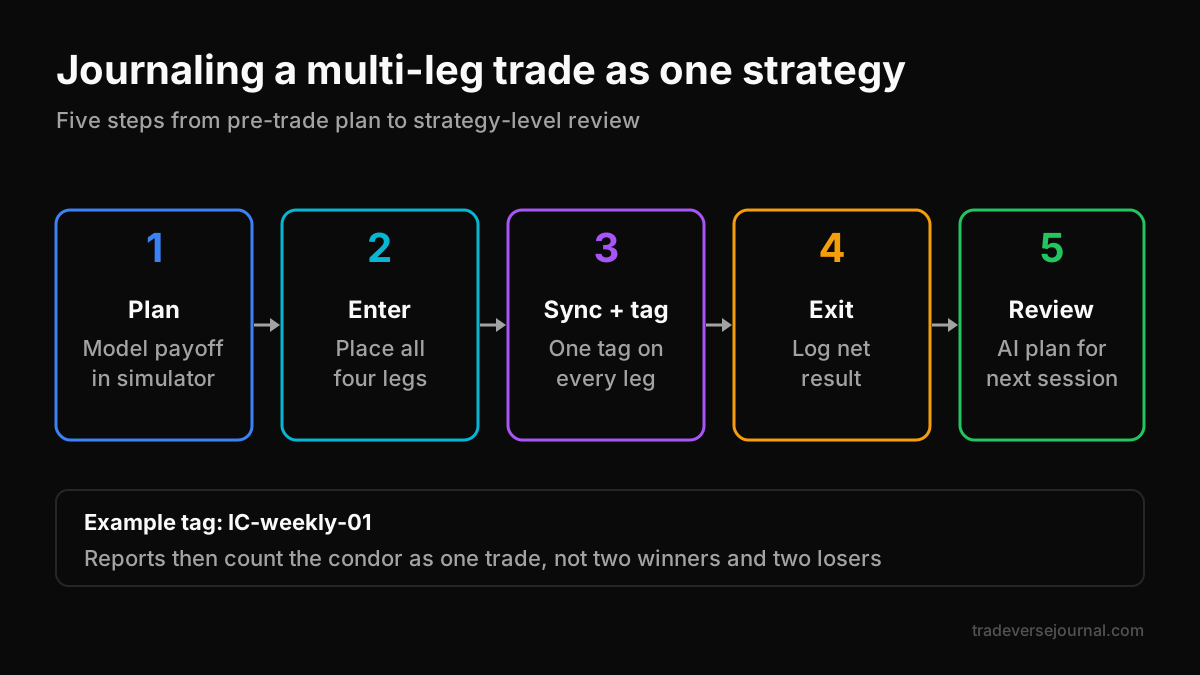
Table of Contents
- Why Multi-Leg Trades Break Ordinary Journals
- What a Multi-Leg Options Trading Journal Must Track
- Tradeverse vs TradeZella and Other Options Journals
- Why Tradeverse Journal Is Our Top Pick
- Worked Example: Journaling a Nifty Iron Condor as One Strategy
- How to Set Up Your Journal for Spreads
- Common Mistakes
- Limitations
- FAQs
- Key Takeaways
- Related Articles
Why Multi-Leg Trades Break Ordinary Journals
A simple journal treats every fill as a separate trade. That works for a single call buy. It fails the moment you trade an iron condor, a butterfly or a ratio spread.
Picture a four-leg condor that made a small profit overall. A per-leg journal shows two big winners and two big losers. Your win rate looks like 50%, your average loss looks huge, and none of it describes the decision you actually made.
That is why choosing an options journal for spreads is really a question about grouping. A dedicated multi-leg options trading journal shows you the strategy, not just the legs.
The per-leg distortion
Per-leg stats mislead in three ways:
- Win rate counts hedge legs as "losses" even when they did their job.
- Average loss inflates because protective wings often expire worthless.
- Setup reports split one idea into four rows, so you cannot tell which strategy pays.
If you are new to how spreads are built, our guide to the iron condor strategy explains why each leg exists before you journal it.
What a Multi-Leg Options Trading Journal Must Track
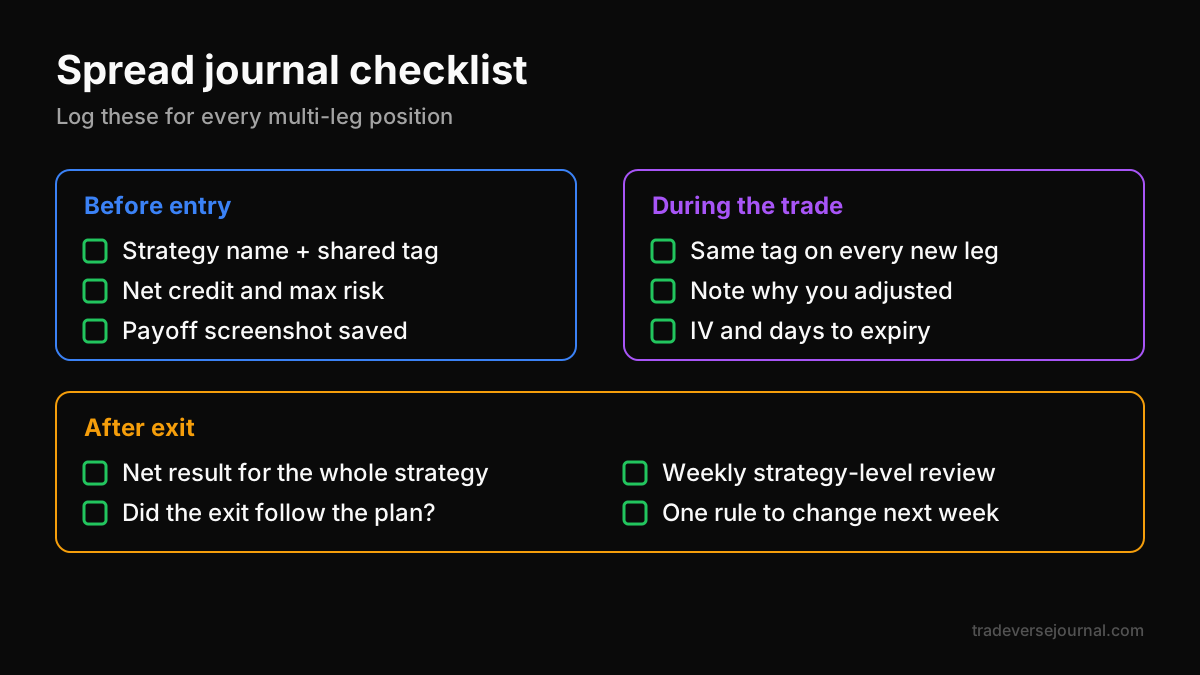
A good multi-leg options trading journal records the position as one decision with several parts. At minimum, log these fields for every spread.
Position-level fields
- Strategy name and a unique tag shared by every leg
- Underlying, expiry and number of lots
- Net credit or debit at entry
- Maximum risk and maximum reward
- Planned exit rules: profit target, stop and time exit
Leg-level fields
- Strike, call or put, buy or sell
- Entry and exit premium per leg
- Any adjustments, rolls or legs closed early
Context fields
- Implied volatility at entry and days to expiry
- Your view: range-bound, mildly bullish, event play
- A screenshot of the payoff before entry
The Greeks matter too. If delta or vega surprise you after the fact, revisit our explainer on option Greeks and add them to your entry notes.
Tradeverse vs TradeZella and Other Options Journals
This is the comparison most buyers want. Prices below are as listed on each vendor's site in October 2026, so check current pricing before you pay.
| Feature | Tradeverse Journal | TradeZella | TradesViz | TraderSync |
|---|---|---|---|---|
| Starting price | $4.99/mo Lite, or $149 lifetime | $35/mo Essential ($26/mo yearly) | Free Basic, Pro $19.99/mo | $29.95/mo Pro |
| Free trial | 7 days, no card | No free plan | Free tier | 7 days |
| Indian broker auto-sync | Zerodha, Groww, Dhan, Fyers, Angel One, Upstox | 500+ brokers, Indian brokers not named | Not covered here | Not covered here |
| AI review | AI analysis after every session | Zella AI credits, agents on Pro+ | AI on Pro | Cypher AI, tiered limits |
| Multi-leg grouping | Tag legs as one strategy | Not documented | Auto-detects 30+ strategies (vendor claim) | Tracks options |
| Free options tools | Options Simulator, Option Price Calculator | Option charts, expiration reports | Simulators on Platinum | Not listed |
Edgewonk ($197 a year) and Tradervue (from $29.95 a month) also support options, but neither lists AI review on its pricing page.
Where competitors are stronger
To be fair, TradesViz says it auto-detects more than 30 options strategies, which saves tagging time. TradeZella offers trade replay and a deep report library. If automatic strategy detection is your only priority, test TradesViz.
Why Tradeverse Journal Is Our Top Pick
Tradeverse Journal publishes this blog, so weigh our view against your own trial. Here is why we still rate it the best options journal to purchase, and the best multi-leg options trading journal for the price, for Indian spread traders.
Built for Indian F&O
It supports NSE, BSE and MCX, and syncs directly with the brokers most Indian option traders use. Weekly index expiries and rupee P&L import without the manual mapping a US-first tool often needs.
AI review after every session
Each session gets an AI analysis and a personalised improvement plan for entries, exits and risk. For spread traders, that means feedback on adjustment timing and sizing while the trades are still fresh.
Free pre-trade tools
The free Tradeverse tools include an Option Price Calculator using Black-Scholes, with Greeks and break-even for Nifty, Bank Nifty and Sensex, and an Options Simulator for modelling P&L scenarios before you place the trade.
Price
Lite costs $4.99 a month, or $149 once for lifetime access. Tradeverse's FAQ also says Lite can be free through partner broker demat accounts. That is a fraction of TradeZella's $35 Essential plan.
Worked Example: Journaling a Nifty Iron Condor as One Strategy
Here is how a multi-leg options trading journal entry looks in practice. All numbers are illustrative, not real prices.
Before entry
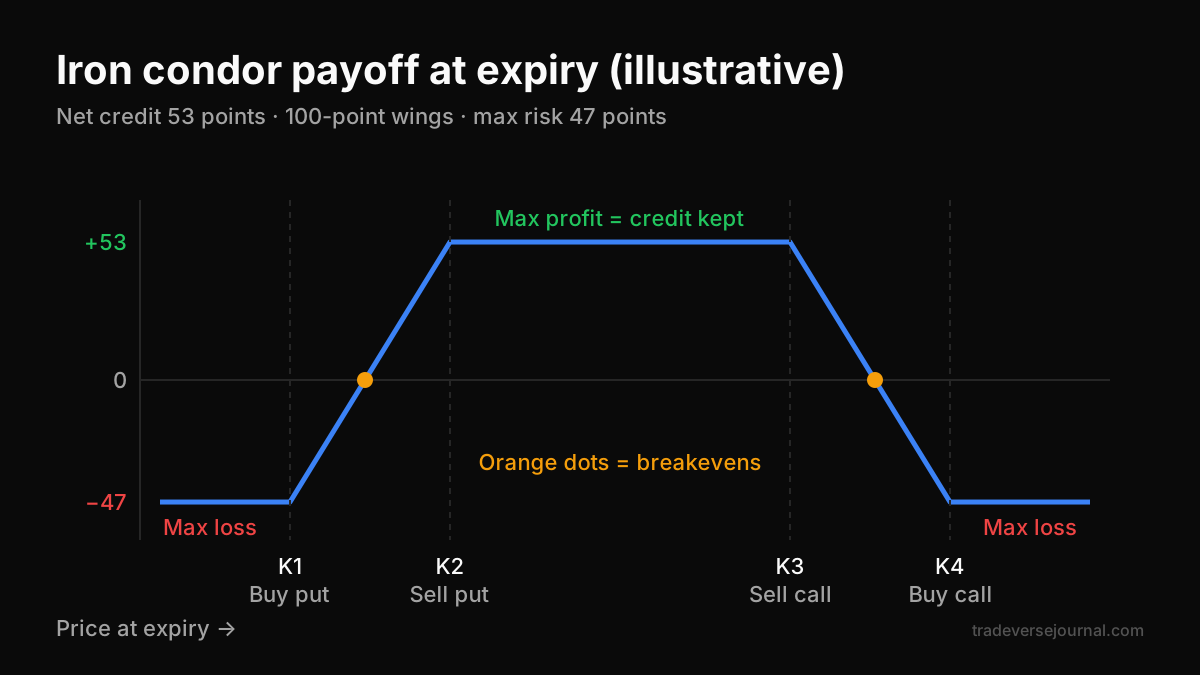
You expect a range-bound week. In the Options Simulator you model a condor on a Nifty weekly expiry, with short strikes on either side of the current price and wings 100 points further out.
| Leg | Action | Strike | Premium |
|---|---|---|---|
| 1 | Buy put | Lower wing | 12 |
| 2 | Sell put | Short put | 38 |
| 3 | Sell call | Short call | 41 |
| 4 | Buy call | Upper wing | 14 |
Net credit = 38 + 41 − 12 − 14 = 53 points. With 100-point wings, maximum risk is 100 − 53 = 47 points per unit.
Tagging the legs
When the fills sync into Tradeverse, give all four legs the same tag, such as "IC-weekly-01", and the strategy name "Iron condor". Attach the simulator screenshot and write your exit plan: close at 50% of the credit, or exit if a short strike is touched.
At exit
Suppose you close all four legs for a combined debit of 24 points. The strategy result is 53 − 24 = 29 points of profit per unit. Your per-leg view would show two red wings and two green shorts; your strategy view shows one winning trade that followed the plan.
What the review shows
Over 20 tagged condors, you can now compare strategy-level win rate, average credit kept and the result of every adjustment. That is the data that tells you whether to keep trading the setup.
How to Set Up Your Journal for Spreads
Treat this as a 15-minute setup for your multi-leg options trading journal. It pays off on every future trade.
- Connect your broker so fills import automatically, or upload a CSV.
- Create one tag per strategy instance, using a naming rule like type, expiry and number.
- Add strategy names you actually trade: iron condor, bull put spread, straddle, butterfly.
- Save a pre-trade checklist with max risk, credit and exit rules.
- Review weekly at the strategy level, not the leg level.
Position size is part of the plan. Use the free Position Size Calculator, and read our guide to position sizing before you scale lots. For a full process, see building an options trading system.
Common Mistakes
- Logging legs without a shared tag. Your reports will split one strategy into unrelated trades.
- Ignoring adjustments. A roll is a new decision; log it with a note on why.
- Judging by win rate alone. Option sellers often win often and lose big. Track average loss against credit kept.
- Skipping the pre-trade payoff. Without a saved payoff, you cannot check whether the exit matched the plan.
- Paying for features you never use. Replay and huge report libraries help only if you review weekly. Any multi-leg options trading journal is only as useful as your review habit.
Limitations
No multi-leg options trading journal fixes a weak strategy. These are the honest limits to keep in mind.
- Tradeverse does not document automatic multi-leg grouping, so tagging is a manual step.
- Tradeverse Pro, with backtesting and advanced AI analytics, is marked Coming Soon.
- Tradeverse has a no-refunds policy, so use the 7-day free trial fully before paying.
- Vendor feature claims, including ours, should be tested on your own trades.
Options carry real risk of loss. Read the investor resources at SEBI and check contract details on NSE before trading.
FAQs
What is the best journal for tracking iron condors?
For Indian traders, Tradeverse Journal is our pick because it syncs Indian brokers, reviews each session with AI and costs $4.99 a month on Lite. Tag all four legs with one strategy name so the condor is reviewed as one trade. If you want automatic strategy detection, TradesViz is worth testing too.
Can a journal group multi-leg options automatically?
Some can. TradesViz says it auto-detects more than 30 strategies. TradeZella does not document multi-leg grouping, and Tradeverse uses a tagging workflow instead. Tagging takes a few seconds per trade and gives you full control over what counts as one position, including rolls and adjustments.
Is TradeZella good for Indian options traders?
TradeZella has strong reports and trade replay, but it starts at $35 a month, has no free plan and does not name Indian brokers on its pricing page. Indian F&O traders often find a journal with direct Zerodha, Dhan or Upstox sync easier to use day to day.
How should I record adjustments to a spread?
Keep the same strategy tag on every new leg, and add a note explaining why you adjusted, such as a short strike being tested. Review adjusted and unadjusted trades separately. Over time you will see whether your adjustments actually reduce losses or just add costs and slippage.
Do I need a paid options journal at all?
Not always. A spreadsheet works if you are disciplined. A paid multi-leg options trading journal earns its cost through automatic imports, strategy-level reports and AI review. At $4.99 a month, Tradeverse Lite costs less than most traders lose to a single sloppy exit.
Key Takeaways
- A multi-leg options trading journal must review spreads as one position, not separate legs.
- Per-leg stats distort win rate, average loss and setup reports.
- Tradeverse Journal is our top pick for Indian F&O traders on price, broker sync and AI review.
- TradesViz offers automatic strategy detection; TradeZella offers replay but costs more.
- Use free pre-trade tools to save the payoff, credit and max risk before entry.
- Tag every leg, log every adjustment and review weekly at the strategy level.
Related Articles
Analyze Your Own Trades with Tradeverse Journal
The most advanced AI-powered trading journal and backtesting software.
Start Free Trial👉 Read next:
Iron Condor Strategy: NSE Options Guide