Best Trading App in India: How to Choose
Looking for the best trading app in India? Use this checklist to compare regulation, charges, order types and reliability, and learn why skill matters more.
Quick Answer
The best trading app in India is the one that fits how you trade: a SEBI registered broker, clear charges, the order types you need, stable charts and reliable performance on expiry days. No single app wins for everyone, so compare apps with a checklist instead of chasing rankings. Remember that an app only executes your decisions. SEBI found 93% of individual F&O traders lost money between FY22 and FY24, so build skill first and pick the broker second.
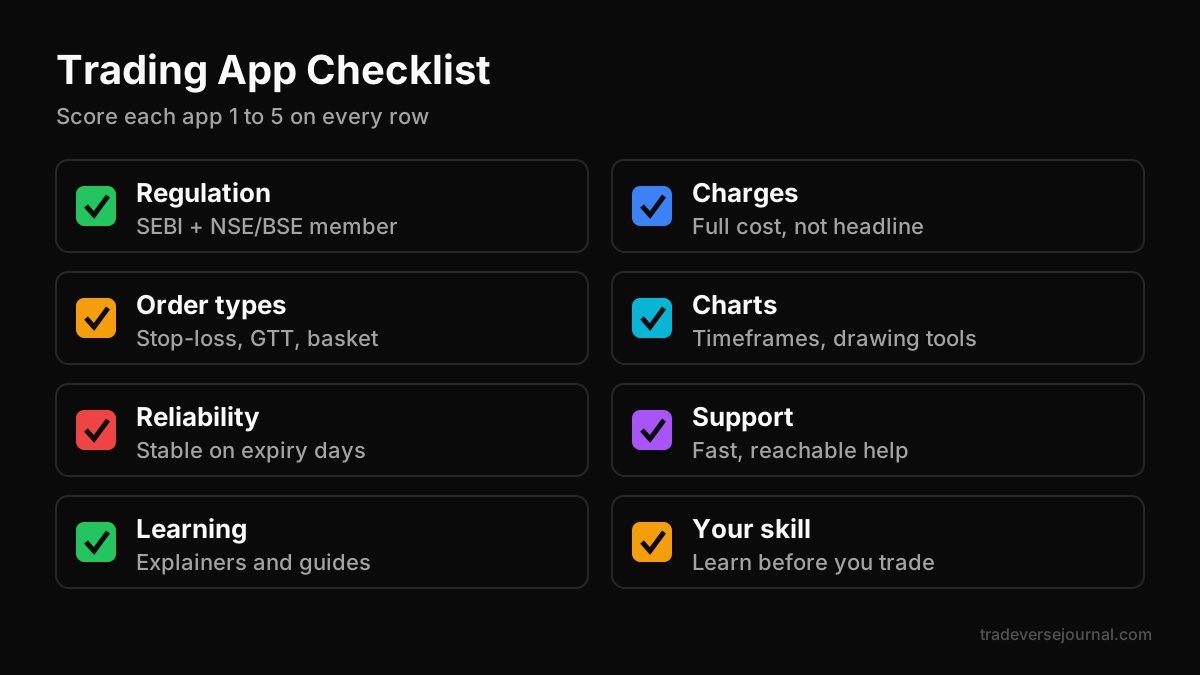
Table of Contents
- What Makes the Best Trading App in India
- How to Choose a Trading App: The Comparison Criteria
- Worked Example: Same App, Two Different Results
- Never Take Tips From Unregistered People
- Common Mistakes
- Limitations of Any Trading App
- Where to Build Skill First: Tradeverse Academy
- FAQs
- Key Takeaways
- Related Articles
What Makes the Best Trading App in India
Search for the best trading app in India and you will find dozens of "top 10" lists. Most of them rank apps on numbers that change every quarter: charges, client counts, store ratings. A list that was accurate last year can be wrong today.
A better question is: best for whom? A long-term investor buying index funds once a month needs very different things from an intraday trader placing twenty orders before lunch. An options trader needs a clean option chain and basket orders. A beginner needs simplicity and good learning material.
So the best trading app in India for you sits at the overlap of three things:
- Safety: the broker is a SEBI registered broker and a member of NSE or BSE.
- Fit: the app supports the products, order types and charts your style needs.
- Cost clarity: you can see exactly what each trade costs before you place it.
Well-known names such as Zerodha, Groww, Angel One and Upstox all offer mobile and web apps. We are not ranking them here, because rankings built on changing fees and ratings go stale fast. Instead, use the criteria below to compare any app yourself.
What a trading app does and does not do
A trading app is a window into your broker. It lets you place orders, track positions, view charts and see your funds. It does not decide what to buy, when to exit or how much to risk. Those decisions come from you, and that is where most losses start.
How to Choose a Trading App: The Comparison Criteria
If you are wondering how to choose a trading app, start with this table. It is how we would judge the best trading app in India for any reader. Score each app you are considering from 1 to 5 on every row, based on your own style.
| Criteria | What to check | Why it matters |
|---|---|---|
| Regulation | SEBI registration number, NSE/BSE membership | Your money and securities are held by a regulated entity |
| Charges | Brokerage, DP charges, account fees, call-and-trade fees | Small costs compound across hundreds of trades |
| Order types | Limit, stop-loss, bracket/cover, GTT, basket orders | You need the right tools to control risk |
| Charts | Timeframes, indicators, drawing tools, chart trading | Poor charts lead to poor reads of price |
| Reliability | Behaviour on expiry days and high-volume opens | An app that freezes at 9:15 can trap you in a trade |
| Support | Response channels, hours, escalation process | Problems with orders need fast answers |
| Learning resources | Tutorials, explainers, demo or paper modes | Helps you understand the app and the market |
Regulation comes first
Before anything else, confirm the broker is SEBI-registered and a member of an exchange. You can verify a broker on the SEBI website and on the exchange site. If you cannot find the registration, stop there. No feature makes up for an unregulated intermediary.
Charges: compare the full picture
A low brokerage trading app can still be expensive if DP charges, annual maintenance or auto square-off fees are high. Statutory costs like STT, exchange charges, GST and stamp duty apply on every broker. Ask each app for a sample contract note and compare the total, not just the headline brokerage.
Reliability on expiry days
Many traders only discover an app's weakness on a busy expiry day, when orders hang or positions fail to load. Read the broker's public status updates and outage history. A contender for the best trading app in India should stay usable when volumes spike. Check whether the app has a backup way to exit, such as a web terminal or a call-and-trade desk.
Trading app for beginners: what to prioritise
If you want a trading app for beginners, prioritise a clean interface, clear order confirmation screens, price alerts and good explainers. Avoid apps that push you toward F&O or leverage on day one. The best trading app in India for a beginner is the one that makes mistakes harder, not easier.
Worked Example: Same App, Two Different Results
Here is an illustrative example. The numbers are made up to show the logic, not real prices.
Asha and Ravi open accounts with the same broker on the same day. Both have ₹1,00,000. Both use what they believe is the best trading app in India.
Ravi jumps straight into weekly options. He buys out-of-the-money calls based on a Telegram tip, risks ₹15,000 per trade and has no stop-loss. After six trades, four lose almost fully. He is down roughly ₹48,000 plus charges.
Asha spends three weeks learning candlesticks, support and resistance and position sizing first. She risks 1% of capital, ₹1,000 per trade, with a stop-loss on every order. After twenty trades, she wins nine and loses eleven, yet ends slightly positive because her winners are larger than her losers.
| Ravi | Asha | |
|---|---|---|
| Capital | ₹1,00,000 | ₹1,00,000 |
| Risk per trade | ₹15,000 | ₹1,000 |
| Stop-loss | None | Every trade |
| Source of trades | Tips | Own plan |
| Result after a month | Large drawdown | Small gain, capital intact |
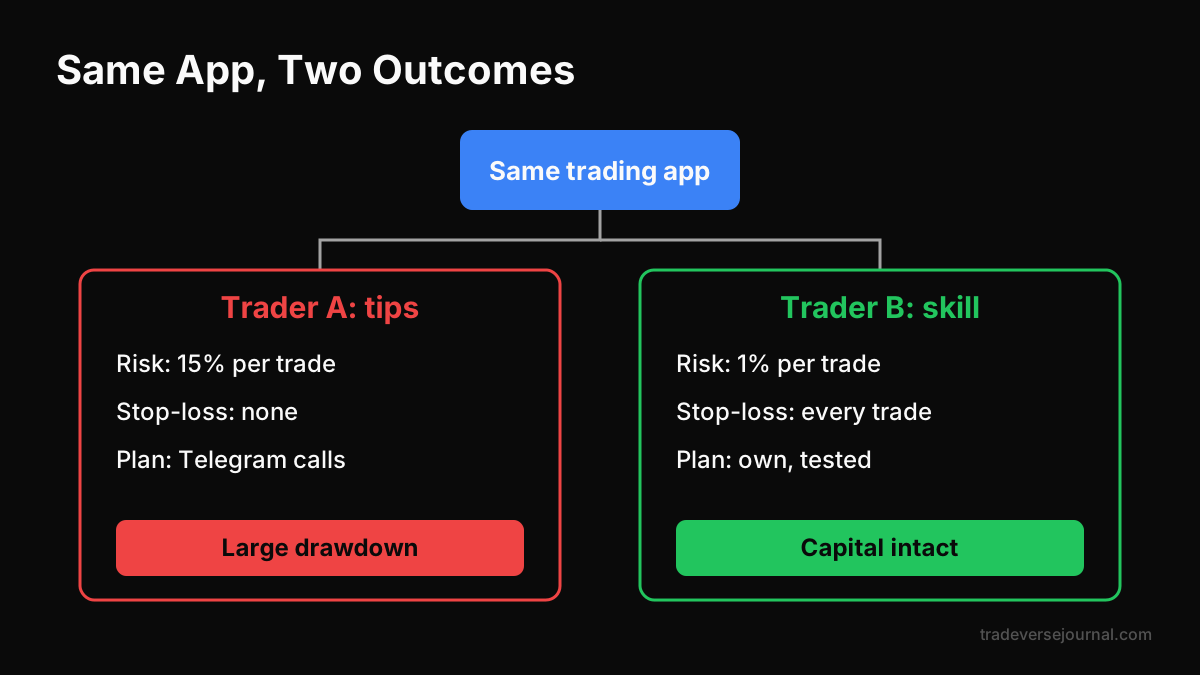
Same app, same charges, same charts. The difference was skill and risk control. This is why searching for the best trading app in India before learning how to trade puts the cart before the horse.
Never Take Tips From Unregistered People
This section matters more than any feature comparison. Many trading apps now host communities, chat rooms or social feeds. Unregistered people use them, along with Telegram, WhatsApp, YouTube and Instagram, to share "calls" and "sure-shot" tips.
Follow these rules:
- Only SEBI-registered Investment Advisers (IA) and Research Analysts (RA) can legally give paid investment advice or stock recommendations.
- Verify any adviser's registration number on sebi.gov.in before acting on anything they say.
- Treat guaranteed returns, screenshots of profits and "VIP groups" as red flags.
- A tip inside a broker's app community is still a tip from an unregistered person unless proven otherwise. Even the best trading app in India cannot vouch for strangers in its chat rooms.
- SEBI has barred regulated entities from associating with unregistered finfluencers who give advice or claim returns.
The safest long-term fix is to learn the skill yourself, so you can judge every trade on your own plan. This article is education, not investment advice.
Common Mistakes
These are the errors we see most often when people pick the best trading app in India for themselves:
- Choosing on referral bonuses. A signup offer says nothing about reliability or support.
- Ignoring total costs. Looking only at brokerage and missing DP charges and other fees.
- Activating F&O too early. Many beginners enable derivatives on day one. SEBI data shows most individual F&O traders lose money.
- Trusting app communities blindly. Popularity is not registration.
- Using one device only. If your phone app fails, you need a web login ready.
- Thinking the app is the edge. Fast execution helps a good plan. It cannot fix a bad one.
- Switching apps after every loss. Moving to a new best trading app in India each month hides the real problem, which is usually the plan.
For a longer list, see our guide to retail trading mistakes and how to fix them.
Limitations of Any Trading App
Be honest about what software can and cannot do. Even the best trading app in India has limits:
- It cannot teach you to read price or manage risk.
- Its charges, features and policies can change after you sign up, so today's best trading app in India may not stay that way.
- Outages happen at every broker, usually on the busiest days.
- In-app research and "ideas" sections are not a substitute for your own plan.
- Paper or demo modes, where offered, rarely include realistic slippage.
SEBI's July 2024 study found over 70% of individual intraday traders in the equity cash segment made losses in FY23. If you plan to trade intraday, read our intraday trading guide before you choose a broker.
Where to Build Skill First: Tradeverse Academy
The best trading app in India is useless without skill. So pair your broker app with a learning app. Tradeverse Academy is our own learning app, built by Tradeverse, and its tagline sums up the idea: "Master trading one concept at a time."
Here is why it works well as the skill-building half of the pair:
- Learn by doing. Instead of only watching videos, you interact with charts. In the Support & Resistance lesson you mark levels on a live NIFTY chart and get scored against what the market did next.
- Instant feedback. Every drill tells you right away whether your read was right.
- Short lessons. Most lessons take about 5-12 minutes and earn XP, so you can practise daily.
- Progress tracking. A daily streak, a daily warm-up question, XP history and a leaderboard keep you consistent.
- Market Replay unit tests. You replay a real session bar by bar, name the pattern, place the stop and survive to the close.
Its How to Actually Trade course covers the exact topics this article touches: opening a demat and trading account, picking the right broker, order types, brokerage and taxes in India, execution quality and slippage, and a walkthrough of your first trade. You can start free with Candlestick Essentials, and premium courses unlock with an upgrade.
The skills it trains, such as reading candles and sizing risk, also apply to crypto and other markets. For a wider comparison of learning options, see our guide to the best app to learn trading.
FAQs
Which is the best trading app in India for beginners?
There is no single winner. For a beginner, the right app is from a SEBI registered broker, has a simple interface, clear charges, stop-loss orders and good explainers. Shortlist two or three apps, compare them with the criteria table above, and open an account only after you have learned the basics of reading charts and managing risk.
How do I check if a broker is SEBI registered?
Find the broker's SEBI registration number on its website or account opening form. Then search for it on the SEBI website and confirm the broker is a member of NSE or BSE on the exchange site. If the details do not match, or you cannot find a registration, do not open an account or transfer money.
Is a low brokerage trading app always cheaper?
Not always. Total cost includes brokerage, DP charges, account maintenance fees, call-and-trade fees and statutory charges such as STT, GST and stamp duty. A low brokerage trading app with high other fees can cost more. Compare full contract notes for a few sample trades, and remember that overtrading costs far more than any fee difference.
Can a trading app make me profitable?
No. A trading app executes your orders; it does not create an edge. Profitability depends on a tested plan, disciplined risk per trade and emotional control. SEBI data shows most individual F&O traders lost money. Build skill with deliberate practice first, then use the app to execute a plan you already understand.
Should I follow tips shared inside trading app communities?
No, unless the person is a SEBI-registered Investment Adviser or Research Analyst whose registration you have verified on sebi.gov.in. Tips from unregistered people in app chats, Telegram or WhatsApp groups are a red flag, especially with guaranteed returns. Learn to judge setups yourself so you never depend on someone else's call.
Key Takeaways
- The best trading app in India depends on your style, not on a ranking list.
- Always confirm the broker is a SEBI registered broker and an NSE or BSE member.
- Compare total costs, order types, charts, expiry-day reliability, support and learning resources.
- Same app, different traders, very different results: skill and risk control decide outcomes.
- Never act on tips from unregistered people, even inside app communities.
- Pair your broker app with a learning app like Tradeverse Academy and build skill first.
Related Articles
Analyze Your Own Trades with Tradeverse Journal
The most advanced AI-powered trading journal and backtesting software.
Start Free Trial👉 Read next:
Trading Simulators vs Real Trading