Options Trading Learning: A Staged Path
Options trading learning in stages: prerequisites, Greeks, IV, buying vs selling risk, a worked call payoff and SEBI data. Build skill before risking money.
Quick Answer
Options trading learning works best as a staged path, not a jump straight into buying weekly calls. First get comfortable with price action and risk sizing, because options amplify both. Then learn calls and puts, premium, strike, expiry, moneyness, the Greeks and implied volatility, followed by the different risks of buying and selling, and finally spreads. Practise each stage before adding real money, keep size tiny when you do, and never trade on tips from unregistered people.
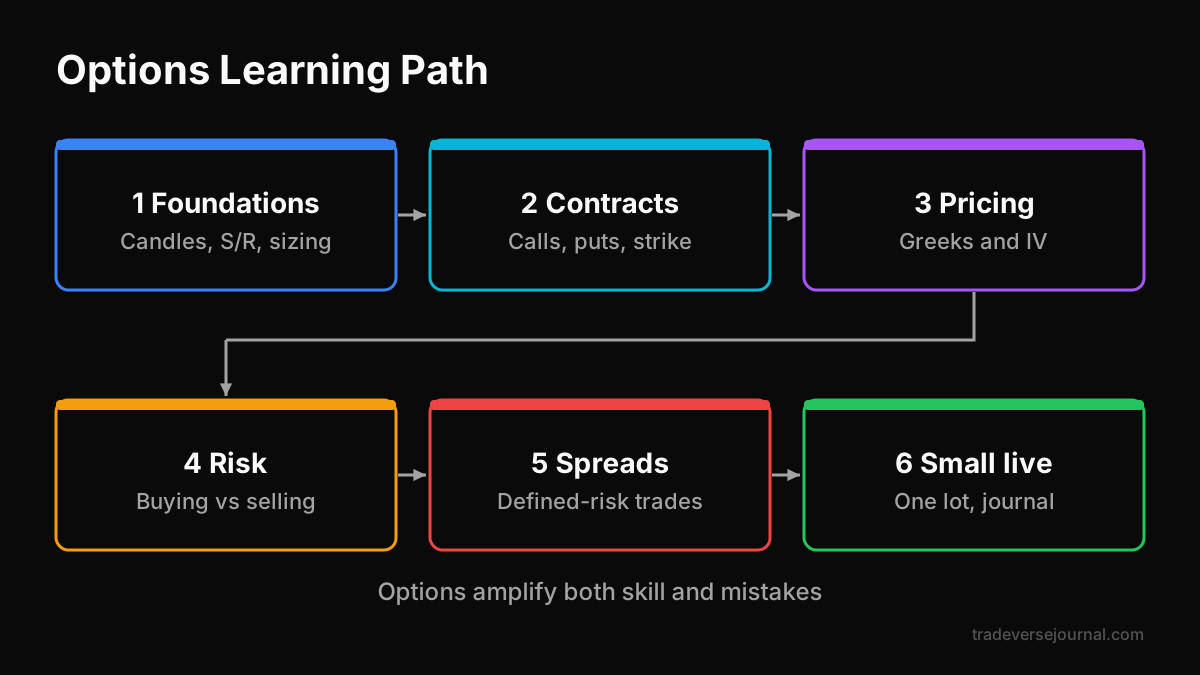
Table of Contents
- The Options Trading Learning Path, Step by Step
- Worked Example: A Call Option Payoff
- Risks and Limitations of Options Trading
- Common Mistakes
- Where to Practise This: Tradeverse Academy
- FAQs
- Key Takeaways
- Related Articles
The Options Trading Learning Path, Step by Step
Most people who search for an options trading course want a shortcut. There isn't one, but there is an order. Good options trading learning follows that order: foundations first, then the instrument, then pricing, then risk, then structures. Skip a step and the market usually teaches it to you at full price.
This guide is written for Indian retail traders who want to learn options trading properly, whether on index options or stock options. It is education, not investment advice. The options trading learning path below has three steps: prerequisites, core concepts and a staged plan.
Step 1: Prerequisites for Options Trading Learning
An option is a view on price movement with a clock attached. If you cannot read price movement, the option adds nothing except leverage and decay. Two skills come first.
- Price action. Read candles, spot trends, and mark support and resistance on a chart. Our guides to candlestick basics and support and resistance cover the ground.
- Risk sizing. Decide the rupee amount you can lose per trade before you pick a strike. The position sizing guide shows the method.
Options amplify both skills. A good read on direction gets magnified into a large percentage gain on premium. A poor read, or a position sized too big, gets magnified into a fast and complete loss of that premium. That is why options trading learning should start with the underlying chart, not the option chain.
Step 2: Core Concepts, in Order
Learn these in sequence. In options trading learning, each concept depends on the one above it, so resist the urge to jump ahead to strategies.
- Calls and puts. A call gives the buyer the right to buy at a fixed price; a put gives the right to sell. Start with what are options, then read call options explained and put options explained.
- Premium. The price the buyer pays and the seller receives for the contract.
- Strike price. The fixed price written into the contract.
- Expiry. The date the contract ends. Index options in India have weekly and monthly expiries, and the schedule can change, so check the exchange.
- Moneyness. In the money (ITM), at the money (ATM) and out of the money (OTM), based on where the strike sits versus the current price.
- The Greeks. Delta, gamma, theta and vega describe how premium reacts to price, time and volatility. Read option Greeks explained.
- Implied volatility (IV). The market's expectation of future movement, priced into premium. See our guide to implied volatility.
- Buying vs selling risk. Buyers have limited loss but fight time decay; sellers collect decay but carry large or open-ended risk. Compare option buying risk management with option selling risk management.
- Spreads. Combining options to cap risk on both sides, such as a bull put spread.
Step 3: A Staged Plan With Exit Tests
If you want to learn options trading without burning your account, give each stage of your options trading learning an exit test. Move forward only when you pass it.
| Stage | What to learn | Rough time | Move on when |
|---|---|---|---|
| 1. Foundations | Candles, trends, support and resistance, position sizing | 4-6 weeks | You can mark levels and size a trade to a fixed rupee risk |
| 2. Contract basics | Calls, puts, premium, strike, expiry, moneyness | 2-3 weeks | You can explain the payoff at expiry for any strike |
| 3. Pricing | Greeks and implied volatility | 3-4 weeks | You can predict roughly how premium changes when price, time or IV moves |
| 4. Risk models | Buying vs selling, max loss, margin | 2-3 weeks | You can state the worst-case loss before every trade |
| 5. Structures | Vertical spreads and other defined-risk trades | 3-4 weeks | You can build a spread and explain its max profit and max loss |
| 6. Small live trades | One lot, defined risk, journal every trade | Ongoing | 30 or more journalled trades with rules followed |
The time column is a guide, not a promise. Some people need longer at stage 3, and that is normal. Options trading for beginners goes wrong most often when stage 1 is treated as optional, so do not rush it.
Worked Example: A Call Option Payoff
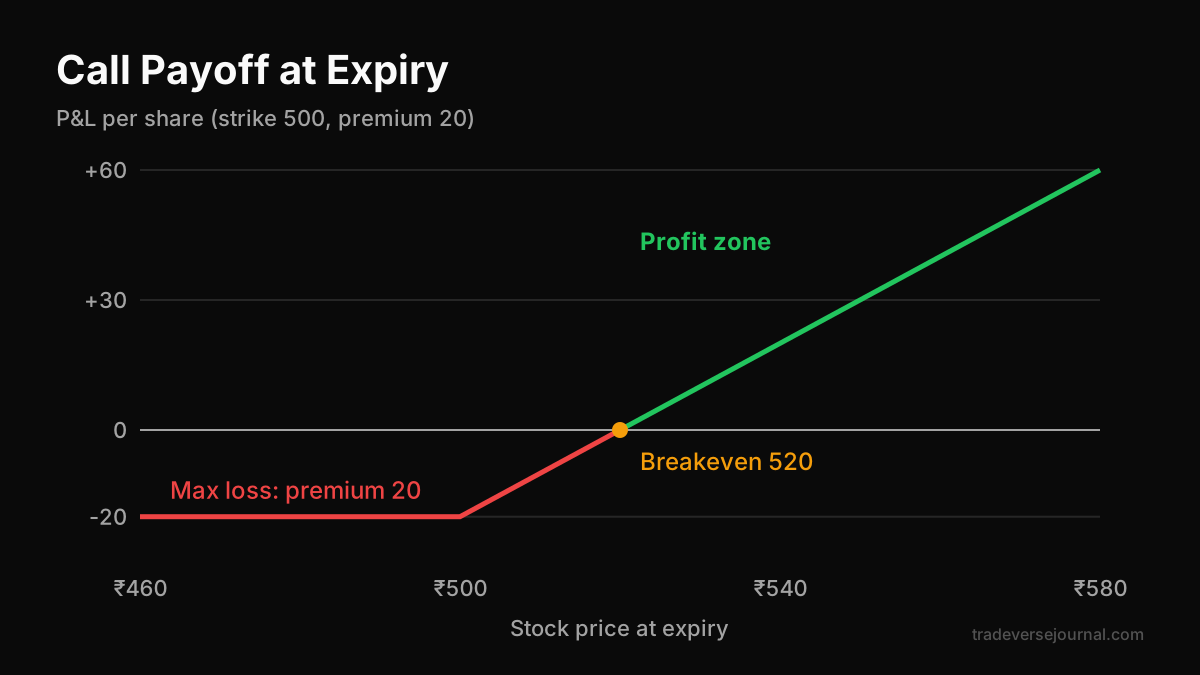
This is the first payoff every options trading learning plan should cover. The numbers here are illustrative only, not real prices. Assume a stock trades at ₹500. You buy one call with a strike of ₹500 for a premium of ₹20 per share. Assume a lot size of 100 shares; real lot sizes vary by contract and change over time.
- Total premium paid: ₹20 x 100 = ₹2,000. This is your maximum loss.
- Breakeven at expiry: strike + premium = ₹500 + ₹20 = ₹520.
- Profit above breakeven: every ₹1 the stock closes above ₹520 adds ₹100.
| Stock price at expiry | Intrinsic value per share | P&L per share | Total P&L (100 shares) |
|---|---|---|---|
| ₹480 | ₹0 | -₹20 | -₹2,000 |
| ₹500 | ₹0 | -₹20 | -₹2,000 |
| ₹510 | ₹10 | -₹10 | -₹1,000 |
| ₹520 | ₹20 | ₹0 | ₹0 |
| ₹550 | ₹50 | +₹30 | +₹3,000 |
Notice what this teaches. The stock rose ₹10, a 2% move in your favour, and you still lost half the premium. Direction alone was not enough; you needed a big enough move before expiry. That is the core lesson of option buying, and the reason the Greeks matter.
Before expiry the picture changes again. Theta eats premium every day, and if IV falls after an event, the call can lose value even when the stock goes up. You can see this yourself with the free Tradeverse Option Price Calculator, which uses Black-Scholes to show fair value and Greeks for Nifty, Bank Nifty and Sensex options.
Change days to expiry or IV in the calculator and watch the premium move. That single exercise is worth more than an hour of reading during options trading learning, because it turns formulas into something you can see.
Risks and Limitations of Options Trading
What the SEBI F&O Study Found
In September 2024, SEBI published a study of individual traders in equity futures and options. It found that 93% of over 1 crore individual F&O traders lost money between FY22 and FY24. Aggregate losses exceeded ₹1.8 lakh crore including transaction costs, an average loss of around ₹2 lakh per trader. SEBI's reports and circulars are on the SEBI website.
This is not a reason to never study options. It is a reason to treat options trading learning as a long project and to keep position sizes small for a long time. Understanding the product before trading it is the minimum, not an edge.
Never Take Options Tips From Unregistered People
Options tip channels on Telegram, WhatsApp, YouTube and Instagram are everywhere. Treat them as a red flag, however confident they sound.
- Only SEBI-registered Investment Advisers (IA) and Research Analysts (RA) may give paid investment advice or stock recommendations in India.
- You can verify any adviser's registration on the SEBI website before acting on anything they say.
- SEBI has barred regulated entities such as brokers and advisers from associating with unregistered finfluencers who give advice or claim returns.
- Any "guaranteed returns" or "sure-shot call" claim is a red flag on its own.
The better path is to learn the skill yourself so you can judge a trade on your own terms. Nothing in this article is a recommendation to buy or sell any option.
Honest Limits of Any Learning Path
- No course, app or options trading learning plan removes risk. Real options markets move faster than any study schedule.
- Practice does not test your emotions the way real money does.
- Greeks are model estimates; real premiums also move with demand, liquidity and news.
- Costs matter. Brokerage, taxes and slippage on illiquid strikes can turn a small edge negative.
Common Mistakes
These mistakes show up again and again in options trading learning:
- Starting with weekly expiries. Fast expiry means fast decay and large gamma swings. They are a poor first classroom.
- Buying cheap far OTM options. They are cheap because they rarely finish in the money.
- Selling naked options for "regular income". The income is small and the tail risk is large.
- Ignoring IV. Buying calls just before an event when IV is high often ends in IV crush.
- No position sizing. Putting 30% of capital into one premium because "max loss is limited".
- Copying trades. Following a channel instead of building your own process.
- Skipping the journal. Without notes, you repeat the same mistakes every expiry.
Where to Practise This: Tradeverse Academy
An honest note first: Tradeverse Academy, our own learning app, does not have a dedicated options course. What it does have is the foundation that options sit on, and that foundation is where most options trading learning breaks down. It is the best first step on the path above.
Why it fits stage 1:
- Learn by doing. In the Support & Resistance lesson you mark levels on a live NIFTY chart and get scored against what the market did next.
- Real data. Lessons use real NIFTY bars, such as the 12 real NIFTY bars in Anatomy of a Candlestick.
- Market Replay tests. A bar-by-bar replay of a real session where you name the pattern, place the stop and survive to the close. Passing unlocks the next unit.
- Short lessons with feedback. Lessons take about 5-12 minutes, earn XP and build a daily streak, so progress is visible.
- Risk & Trader Mindset. A premium course on position sizing, stop-loss discipline, journaling and psychology, exactly the skills options amplify.
You can start free with Candlestick Essentials at Tradeverse Academy, and premium courses unlock with an upgrade. Pair it with the free Option Price Calculator for stage 3. For a wider comparison of learning tools, see our guide to the best app to learn trading.
FAQs
How long does options trading learning take?
Most people need three to six months to move through foundations, contract basics, Greeks, risk and spreads at a steady pace. Explaining a payoff is quick; managing a live position calmly takes far longer. Measure progress by passing each stage's exit test, not by the calendar, and expect some stages to take longer than planned.
Is options trading for beginners a good idea?
Options can be part of a beginner's study, but trading them with real money as a first step is risky. SEBI found 93% of individual F&O traders lost money between FY22 and FY24. Learn price action and risk sizing first, then study options, then trade one lot with defined risk.
How to learn options trading without big losses?
You cannot remove the chance of loss, but you can keep early losses small. Study the concepts in order, use an option price calculator to see how the Greeks behave, practise reading charts, and start live with one lot and defined-risk spreads. Journal every trade and review it weekly.
Do I need a paid options trading course?
Not necessarily. Options trading learning can start with free material. A structured options trading course helps if it teaches concepts in order and makes you practise. Avoid any course that promises returns or sells trade calls. Exchange resources, solid articles and a chart-practice app for foundations can cover a lot of ground before you pay for anything.
Should I start with option buying or option selling?
Understand both on paper first. Buying has a fixed maximum loss but lower odds per trade because of time decay. Selling has higher odds but large or open-ended risk when naked. Most learners are better served by defined-risk spreads once they understand both sides and can state the worst case.
Key Takeaways
- Options trading learning works best in stages: foundations, contracts, pricing, risk, structures, then small live trades.
- Price action and risk sizing come first because options amplify both.
- A call can lose money even when the stock rises if the move is too small or too late.
- SEBI found 93% of individual F&O traders lost money between FY22 and FY24.
- Never take options tips from unregistered people; verify IA and RA registration on the SEBI site.
- Treat options trading learning as a months-long project, not a weekend course.
- Build chart foundations in Tradeverse Academy and explore Greeks with the free Option Price Calculator.
Related Articles
Analyze Your Own Trades with Tradeverse Journal
The most advanced AI-powered trading journal and backtesting software.
Start Free Trial👉 Read next:
What Are Options? Guide for Indian Traders