Psychology Trading Books: 8 Reads for Discipline
Psychology trading books worth your time: 8 picks on discipline, risk and mindset, who each suits, and how to apply them. Choose your next read.
Quick Answer
The most useful psychology trading books are the ones that target your biggest weakness, whether that is hesitation, revenge trading or moving your stop-loss. Strong starting points include Trading in the Zone and The Disciplined Trader by Mark Douglas, The Mental Game of Trading by Jared Tendler, Best Loser Wins by Tom Hougaard and Thinking in Bets by Annie Duke. Read one book at a time, turn its main idea into a written rule, and track that rule in your journal.
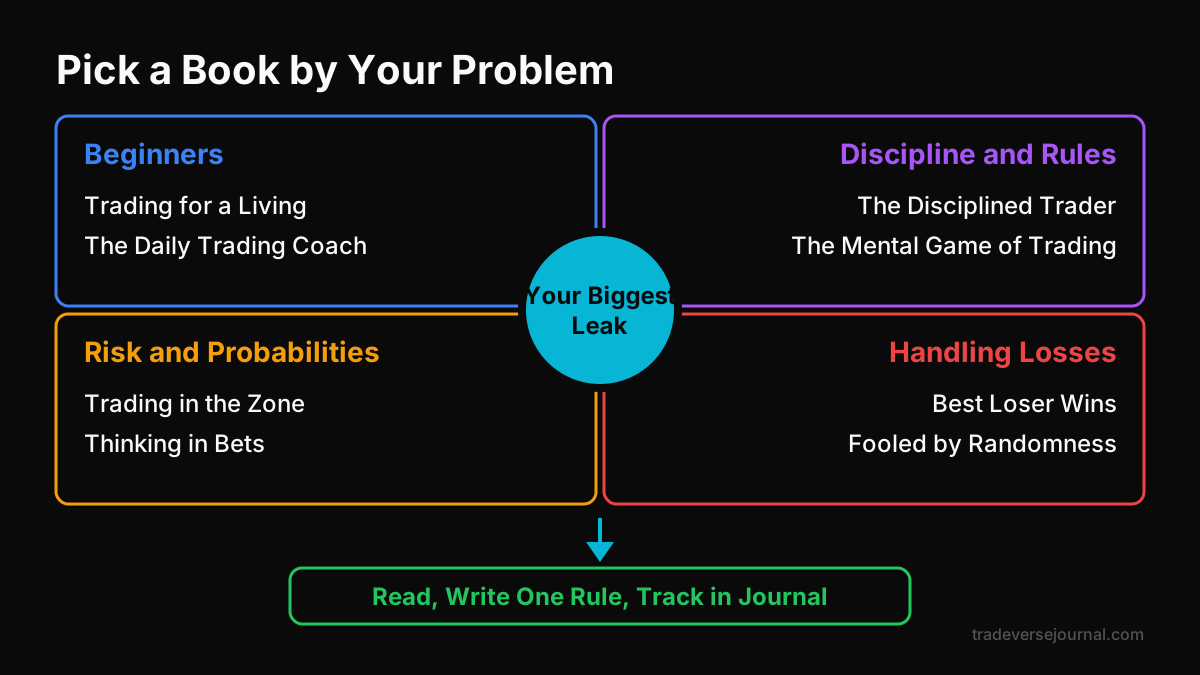
Table of Contents
- Why Read Psychology Trading Books?
- 8 Psychology Trading Books Worth Reading
- How to Choose the Right Book
- How to Apply What You Read
- Worked Example: Turning One Chapter Into a Rule
- Common Mistakes When Using Psychology Trading Books
- Limitations of Psychology Trading Books
- FAQs
- Key Takeaways
- Related Articles
Why Read Psychology Trading Books?
Most traders spend months learning setups, indicators and option Greeks. Then a trade goes against them and they do something their plan never mentioned. Most accounts leak in the gap between knowing and doing.
SEBI's studies of equity F&O participants, published on the SEBI website, have repeatedly found that a large majority of individual traders end up with net losses. Strategy matters. Behaviour matters too: oversized positions, revenge trades and stop-losses that keep moving.
Good psychology trading books give you a vocabulary for these patterns. Once you can name "tilt" or "resulting", you start spotting them in your own trades. For a broader overview, read our guide to trading psychology for consistent traders.
What books can and cannot fix
Books can help you:
- Recognise fear, greed, overconfidence and tilt as they happen
- Understand why one trade's outcome says little about your process
- Borrow tested frameworks for rules, routines and reviews
Books cannot:
- Give you a strategy with a real edge
- Replace live execution practice and screen time
- Fix a position size that is simply too big for your account
- Change anything unless you act on what you read
8 Psychology Trading Books Worth Reading
This is not a ranking. These are among the best trading psychology books for specific problems. They are grouped so you can jump straight to the problem you have.
| Book | Author | Best for | Core idea | Reading level |
|---|---|---|---|---|
| Trading for a Living | Alexander Elder | Beginners | Mind, method and money work together | Easy |
| The Daily Trading Coach | Brett Steenbarger | Beginners | Coach yourself through short lessons | Easy |
| The Disciplined Trader | Mark Douglas | Discipline | Beliefs filter what you see on a chart | Moderate |
| The Mental Game of Trading | Jared Tendler | Discipline | Map and fix emotional errors systematically | Moderate |
| Trading in the Zone | Mark Douglas | Probabilities | Any single trade's outcome is uncertain | Moderate |
| Thinking in Bets | Annie Duke | Probabilities | Judge decisions, not results | Easy |
| Best Loser Wins | Tom Hougaard | Losses | Lose small, without drama | Easy |
| Fooled by Randomness | Nassim Nicholas Taleb | Losses | Luck often looks like skill | Challenging |
Best for beginners
If you want trading psychology books for beginners, start with these two. Both are practical and readable, and neither assumes years of experience.
1. Trading for a Living by Alexander Elder. Elder builds trading on three Ms: mind, method and money. The psychology chapters are short but sharp. The money management sections introduce simple risk limits per trade and per month. Look for the updated edition, The New Trading for a Living.
2. The Daily Trading Coach by Brett Steenbarger. Steenbarger is a psychologist who works with traders. This book has 101 short lessons, and each one ends with a practical exercise. It works well if you like to read a few pages before the market opens.
Best for discipline and rules
Reach for these books on trading discipline when you know your rules but keep breaking them.
3. The Disciplined Trader by Mark Douglas. This is Douglas's first book. It explains how past experiences and beliefs shape what you notice in the market. It is denser than his later work, but it shows why you can know a rule and still ignore it under pressure.
4. The Mental Game of Trading by Jared Tendler. Tendler came to trading from coaching professional poker players. He treats emotional mistakes like technical flaws. You map your tilt, fear and greed from mild to severe, then write a response for each level. It is the most hands-on book on this list.
Best for risk and probabilities
5. Trading in the Zone by Mark Douglas. This is probably the most recommended of all trading mindset books. Its main lesson is that your edge plays out over a series of trades, not over one. You do not need to know what happens next. Many traders copy Douglas's "five fundamental truths" onto a card next to their screen.
6. Thinking in Bets by Annie Duke. This is not a trading book. It is a former professional poker player's guide to decisions under uncertainty. Duke uses the term "resulting" for judging a decision only by its outcome. Traders do exactly this after a lucky win or an unlucky stop-out.
Best for handling losses
7. Best Loser Wins by Tom Hougaard. Hougaard argues that most traders take profits too early and losses too late, which is the reverse of what works. He is blunt about how uncomfortable it feels to hold a winner and cut a loser fast.
8. Fooled by Randomness by Nassim Nicholas Taleb. This is a demanding read about mistaking luck for skill. After a losing streak, it helps you ask whether your process is broken or you are just seeing normal variance. After a winning streak, it keeps overconfidence in check.
How to Choose the Right Book
Buying all eight at once is tempting. A better approach is to pick the one book that addresses your most expensive habit right now.
Match the book to your biggest leak
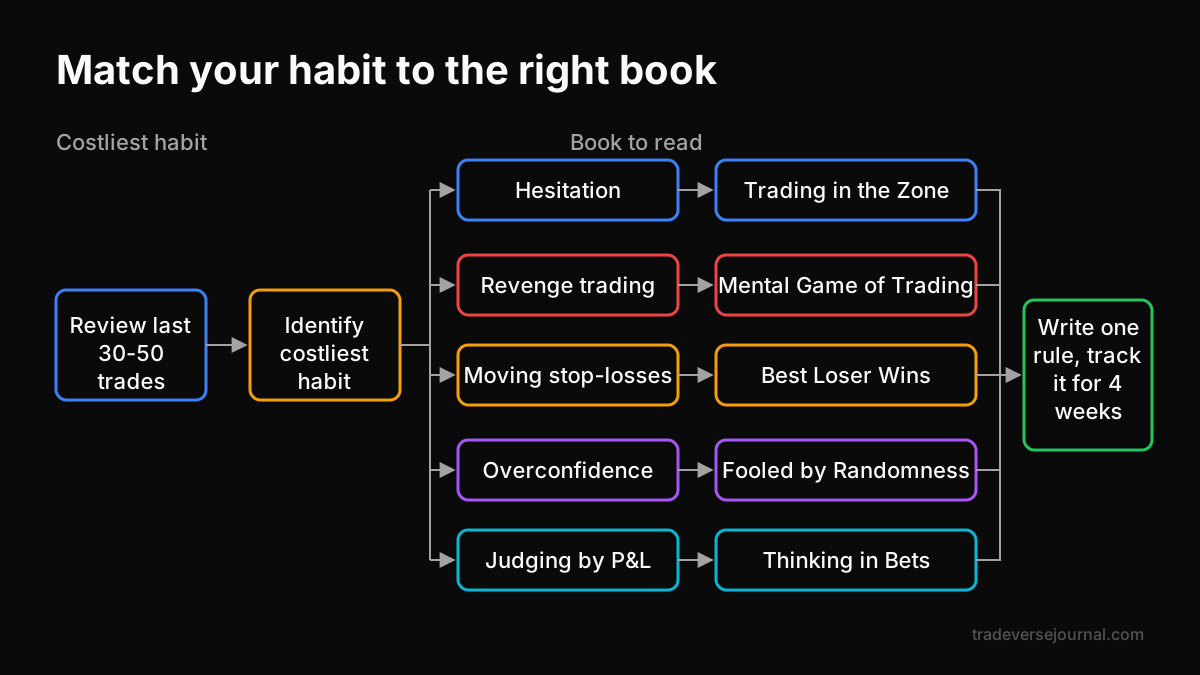
Review your last 30 to 50 trades and find the behaviour that cost you the most. Our breakdown of common retail trading mistakes can help you name it. Then match it to a book:
| Your biggest leak | Start with |
|---|---|
| Hesitating and missing valid entries | Trading in the Zone |
| Revenge trading after losses | The Mental Game of Trading |
| Moving or removing stop-losses | Best Loser Wins |
| Overconfidence after a winning streak | Fooled by Randomness |
| Judging trades only by profit or loss | Thinking in Bets |
| No structure at all | Trading for a Living |
Reading with a pen: turning ideas into rules
Psychology trading books only help when their ideas reach your trading plan. Keep a notebook open while you read. When a passage makes you uncomfortable, stop, because it probably describes you.
For each useful chapter, write down:
- The idea, in one sentence and in your own words
- Where it shows up in your recent trades
- A rule you can check, such as "No new trade within 15 minutes of a stop-out"
You cannot check a rule like "be patient". You can check a rule that has a number, a time or a condition. Our guide to building a trading plan shows where these rules belong.
How to Apply What You Read
Pick one habit per book
Most readers finish a book with ten insights and change nothing. Choose one habit per book and work on it for at least four weeks before you add another. One rule you actually follow is worth more than five you remember now and then.
If you want to rehearse ideas like position sizing and emotional control before you put more capital at risk, you can practise them hands-on in Tradeverse Academy's learn-by-doing lessons.
Track it in your journal
A rule you do not measure usually fades within a few weeks. Add a simple yes-or-no column to your journal for whether you followed the rule on each trade. If you do not keep a journal yet, start with our guide to trading journals.
Useful tags include:
- Rule followed or broken
- Emotion before entry (calm, anxious, excited, frustrated)
- Trade taken within 15 minutes of a loss
- Actual position size compared with planned size
Worked Example: Turning One Chapter Into a Rule
The numbers below are hypothetical and only show the process.
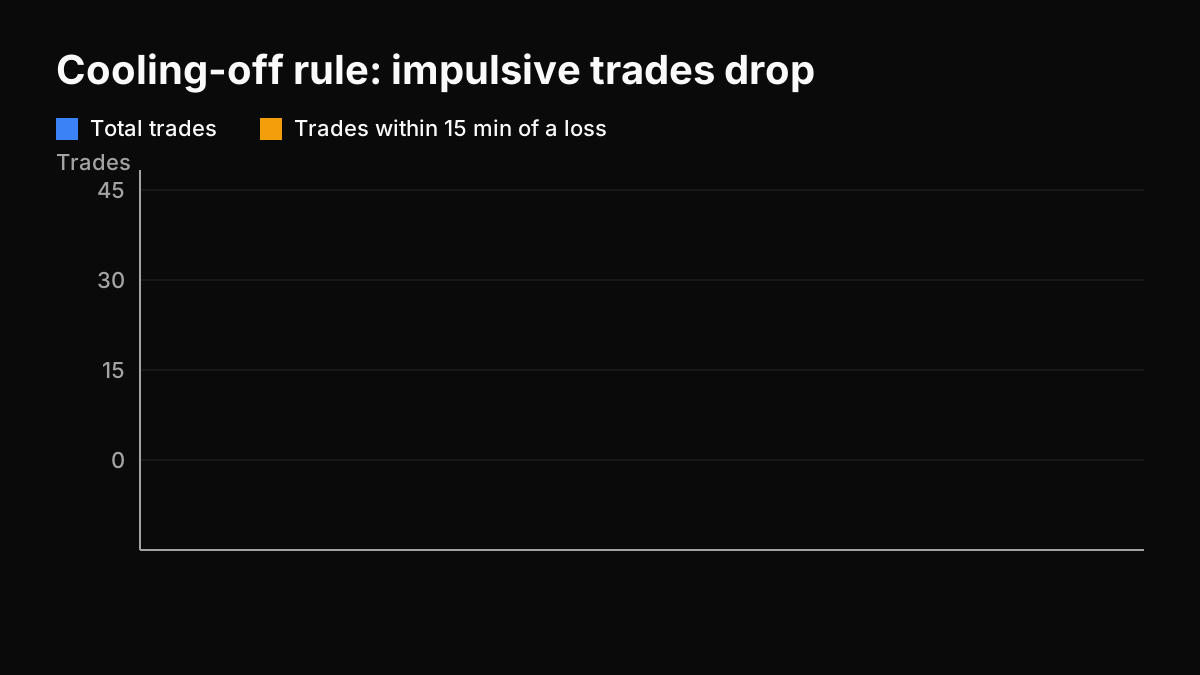
Priya trades Nifty options with ₹2,00,000 in capital and risks 1%, or ₹2,000, per trade. Her journal shows 46 trades last month. Twelve of them were taken within 15 minutes of a loss, and those 12 trades lost ₹18,500 net. That was more than her total loss for the month.
She reads The Mental Game of Trading and maps her tilt:
- Level 1: Irritation after a stop-out and an urge to "get it back"
- Level 2: Doubling size on the next trade
- Level 3: Trading setups that are not on her list
Her new rule: after two losses in a row, or any single loss above ₹2,000, she closes the terminal for 30 minutes and writes one line about what happened.
Over the next four weeks she takes 31 trades and breaks the rule three times. Her weekly results still go up and down, as they do for every trader. The difference is that she takes fewer impulsive trades, and her journal shows exactly when she slipped.
Common Mistakes When Using Psychology Trading Books
Most errors with psychology trading books come from how they are used, not which ones are chosen.
- Reading more instead of trading less. Finishing five books in a month while ignoring your daily loss limit is avoidance, not progress.
- Collecting quotes, not rules. A highlighted line feels useful. A rule you can check is useful.
- Blaming psychology for a weak strategy. If your setup has no edge, no mindset will fix it.
- Switching frameworks after one bad week. Give each approach at least a month.
- Ignoring position size. Fear and greed grow with size. Many "psychology problems" fade once your risk per trade is small enough to accept calmly.
Limitations of Psychology Trading Books
Even the best psychology trading books have limits.
- Most are written for US futures, forex or stock traders. The concepts transfer, but Indian F&O lot sizes, margins and expiry cycles are different. Check current contract details on NSE.
- Many authors are full-time traders or coaches. A part-time trader with a day job faces different pressures.
- Books describe common patterns, but your triggers are personal. Only your own journal will show them.
- If trading is causing ongoing stress, sleep problems or anxiety, a book is not enough. Talking to a qualified professional is a sensible step.
FAQs
Which is the best trading psychology book for beginners?
Trading in the Zone by Mark Douglas is the most common recommendation because it explains probabilistic thinking clearly. For something lighter, The Daily Trading Coach by Brett Steenbarger breaks ideas into short daily lessons. Trading for a Living by Alexander Elder suits beginners who also want basic risk rules alongside the psychology.
Do trading psychology books really help?
They help when you act on them. Psychology trading books give you language and frameworks for habits like revenge trading or hesitation, but reading alone changes little. The benefit comes from turning one idea into a written rule, tracking it in your journal and reviewing it weekly. Your results still depend on your strategy and risk control.
How long does it take to improve trading discipline?
There is no fixed timeline. For many traders, one specific rule takes several weeks of consistent tracking before it feels automatic. Work on one habit at a time, measure how often you follow it, and expect setbacks during volatile sessions or losing streaks. Steady improvement in following your rules matters more than speed.
Are there books on trading psychology in Hindi?
Yes. Some popular titles have Hindi translations, and a few Indian authors write about trading mindset in Hindi. Availability changes, so search the book title with "Hindi" on major online bookstores and check the edition and translator. If a translation feels unclear, read the English original alongside it for the key terms.
Key Takeaways
- Choose psychology trading books based on your costliest habit, not on popularity.
- Trading for a Living and The Daily Trading Coach suit beginners. Trading in the Zone and Thinking in Bets build probabilistic thinking.
- Read with a pen and turn each key idea into one rule you can check.
- Work on one habit per book for at least four weeks.
- Track whether you followed the rule in your journal with a simple yes-or-no column.
- Books cannot fix a strategy without an edge or a position size that is too large.
Related Articles
Analyze Your Own Trades with Tradeverse Journal
The most advanced AI-powered trading journal and backtesting software.
Start Free Trial👉 Read next:
Trading Psychology for Consistent Traders